November 19, 2009

The Gospel; A Mental Exertion


I have recently thought a lot about why we as children of God must go through often very difficult and trying mental challenges, such as depression and despair. Though I can’t say I have the exact answer, I can say I have learned one thing over the past few months as I have battled my own personal mental challenges. Much, if not all of the gospel is a mental exertion. Yes, faith without works is dead (meaning we must act), but you must first believe in your mind before you act. Hope is a mental exercise. Love is changing the way you think about others and allowing new feelings in to your heart and mind. So much of the gospel is learning to control and empower our minds. This is why going through the motions is so dangerous spiritually speaking. The power of faith is not in the action of our hands or feet but in the development of our minds and spirits.

Why must we face problems like depression, anxiety, hopelessness, and despair? I don’t know. Only God knows. But this I do know, God wants us to become like He is, including developing a mind like He has. That means we must go through very painful mental exercises that will help to develop our minds. Just as the athlete who desires to be the fastest in the race must go through great physical pains to come to that point, we too must go through like experiences in order to have the power that God has. If we are to have the faith that God has, we must be faced with challenges that seem far too daunting and then overcome them through the belief in Christ and the belief in ourselves that we can.

I have often asked myself if God has faith and hope. The answer is with no hesitation, yes! All one needs to do is read the Book of Revelation to see the faith and hope of the Lord. The book is set to be in the direst of situations. All hell is breaking lose, the very foundations of humanity are crumbling, sin fills the world, darkness covers the minds of men; yet God shows us His faith and hope by not only saying that good will prevail, but exactly how that will happen. He does not just teach us that He will win by a margin; He teaches us that He will annihilate the enemy and bring eternal harmony to the earth. If anything is hope, this is. In the Guide to the Scriptures it states that hope is “the confident expectation of and longing for the promised blessings of righteousness.” (Hope) Is this not exactly what the Lord teaches us in the Book of Revelation? Is this not what we hope to have? Do we not hope to gain a confidence in the Lord and in ourselves so that we can do all things? If this is the case, then how can we gain the hope and faith that God has?

In the scriptures there are several passages that refer to God giving man weakness. For example in the Book of Mormon it states: “I give unto men weakness that they may be humble; and my grace is sufficient for all men that humble themselves before me; for if they humble themselves before me, and have faith in me, then will I make weak things become strong unto them.” (Ether 12:27) However, note that it does not say that the Lord gives us weaknesses, but weakness; in other words it is not plural. What is this weakness that God gives us? It is not sin, nor despair, nor hopelessness, for God is not the author of these things. We can never blame God for wickedness and unhappiness.

However, I believe that the weakness God has given each of us relates to the condition of the world and the imperfections of mankind. Allow me to explain. God allows us to have agency that we may choose for ourselves. This agency leads to sin, death, despair, pain, and a multitude of other difficulties, or might I call it “weakness.” Thus, God has given us agency that the world may be weak, that mankind may be weak. Why? So that we can learn to have faith as He has. How would we ever learn to have faith if all went right in our life? How would we hope for a better place if we did not already live in that “better place”? For us to learn to believe, act, and be as God is, we must be put in a circumstance—a state of weakness—that will allow us to grow and develop, or in other words, “then will I make weak things become strong unto them.”

Why must we face these difficulties such as depression, anxiety, sadness and despair? Because it is through them we learn to rely on Christ to lift us and in time we learn to lift ourselves that we may have the faith and hope that God and Christ have. When we gain this faith and hope then we can write our own Book of Revelation in which all hell can break loose and yet we will not fear, we will not despair, we will become, we will believe!

November 10, 2009

The Law of Obedience


I have recently thought a lot about the law of obedience. I must say that much of this has been due to the fact that I have struggled with feeling inadequate and unable to live up to all that God asks of us. I also have often seen the commandments as burdensome. I many times could not understand the reason behind the law; they often just seemed more like a checklist. However, in the last few years I have had, I guess you could say, a change of heart. I have seen the commandments not as mindless rules to bind us to the old ways of life, or numbing regulations so as to curtail our enjoyment of life, but instead laws of power taught to us by a loving God who wants us to have dominion and power over all things. In short, He desires that we become even as He is.

Imagine for an instance a chemistry class. The professor walks in and begins teaching his students how they can cause chemical explosions by adding certain elements together. These explosions can then be used to help better the world. One explosion might loosen the debris that has piled on top of an innocent victim after a severe earthquake. Another might be used to explode within the engine of a vehicle so as to power an ambulance on its way to an accident scene. And yet another might be used to prepare the foundation for a building that will be built for the benefit of mankind. As the teacher is explaining the sheer power behind learning certain natural laws a young student raises his hand. “What you are doing is limiting our freedom! I would rather have a class where I can do whatever I want, where I can just do as I please. You teaching us all these laws and requiring us to follow such strict measures only limits my abilities.”

I unfortunately have often found myself making similar claims to God. When asked why God gave us commandments I would give the standard answers that He knows what is best, or He wants us to choose the right. Though these are true, one must ask why one thing is right and another thing is wrong? Why does God want us to obey the laws as they are? If He is God, can He not change them to whatever He feels is right?

Law is power and power is in law. Just as the chemist or physicist who learn to obey certain chemical or physical laws can harness the power of an atom and produce an atomic bomb, so God gains power over all things by obeying the laws of nature. Why does God give us the laws He does? Because He knows the power that lies within them. What makes these laws right? Because of the power that they wield when obeyed.

God in His infinite mercy teaches us laws of the universe not to limit us but to empower and enable us to become as He is. He does not have us obey laws just so we can be found worthy to join the choirs that will sing eternal praises to Him as He sits upon His yonder throne. No, if God wanted this, He would have made the requirements for salvation a doctorate in coral singing, not faith in Christ and repentance. If God wanted concourses of angels to serve Him forever more, He would have made culinary education and butlery skills as a requirement for exaltation and not love towards our neighbor.

As Elder Neal A. Maxwell said so powerfully “it isn’t that God seeks to shape us capriciously, just to prove that He is in charge; He is fitting us for special chores for which there are righteous and nonwaivable specifications.” In other words, God knows how to be a god, and he desires us to learn these same attributes. He desires that the joy and happiness that He has can be ours and thus gives us laws that we may learn how to come to that point.

Because God loves us He ensures that every command and every law will bring us to His eternal glory and allow us to partake of His power, dominion, and authority. I would invite you from this day to look at each commandment not with the eye of what is right and wrong (though they are that), but to instead look at them with the eye of learning who God is, learning why God is the way He is. For “this is life eternal, that they might know thee the only true God, and Jesus Christ, whom thou hast sent.” (John 17:3)

November 7, 2009

Remember the Captivity of Your Fathers


This last summer my family and I went to the Yale University Special Collections Library to sift through boxes and boxes of information they had on one of my ancestors who served in the Civil War. Of the many treasures we found was a letter written to my ancestor James E. Fuller (who at the time was an enlisted soldier in the Union Army) from his father Ebenezer Fuller dated October 24, 1865. It appears that James was going through a great deal of struggles at this time of his life. His father penned these words of inspiration to him with the hopes of lifting his son’s soul that he might be sustained at this great and trying time of his life:

“You are not the first or only noble soul that has met disappointment - no, no. Show that you can master adversity, and turn all things, however disagreeable they may be, to the accomplishment of your own places and purchases. I am thankful for all the adversity and losses I have had, for it has made me richer and wiser and absolutely increased my sense of human happiness. Be encouraged then to never despond, or to look at your own lot in the ‘drama of life’ as any more severe than your greatest happiness and but good, require adversity, benefits, assuredly – forget not Life is but a breath and Eternity our Home. Affectionately, E. Fuller”

Alma in the Book of Mormon was told by the angel of God to remember the captivity of his fathers and to remember the “great things [the Lord had] done for them; for they were in bondage, and he has delivered them.” (Mosiah 27:16) As I thought upon my ancestor who at the time was fighting in the bloodiest war the United States has ever fought, and how he in time was delivered from the tribulations of war, I thought of this verse and of my own challenges I am currently facing.

Life is not easy. I don’t know any other way to put it. However, the trials we face have a unique ability to refine us like no other experience in our life. In the words of Elder Neal A. Maxwell, a modern day apostle “The thermostat on the furnace of affliction will not have been set too high for us—though clearly we may think so at the time. Our God is a refining God who has been tempering soul-steel for a very long time. He knows when the right edge has been put upon our excellence and also when there is more in us than we have yet given. One day we will praise God for taking us near to our limits—as He did His Only Begotten in Gethsemane and Calvary.” (All These Things Shall Give Thee Experience, page 46)

In the end I am not sure if I will be able to overcome all the trials I currently face, but as Paul so eloquently stated, I feel to exclaim: “We are troubled on every side, yet not distressed; we are perplexed, but not in despair; persecuted, but not forsaken; cast down, but not destroyed” (1 Cor. 4:8-9).

I do not know what the Lord has in store for me or for those who surround me. But this I know, God has, does, and will forever more deliver His people from spiritual and physical captivity. Through the atonement of Christ all mankind can be given power to be freed from all captivity, whatever that may be. Though we know not when the Lord will remove our own thorns in our flesh (see 2 Cor. 12:7), we can know that He not only has the power to do so, but if we will trust in Him and have Faith in Him He will make all things right. In the eternities those who put their faith in Christ will be made whole. Truly as my ancestor said “Life is but a breath and Eternity our Home.”

(Photo of James E. Fuller during Civil War, courtesy of the Beinecke Rare Book and Manuscript Library at Yale University)

October 7, 2009

The Power of Choice


The past few months have been, well, difficult to put it mildly. With school starting, many new responsibilities, and just life in general I found myself at one of those times in life where I just wondered how I would make it to the next day. Amidst this challenging time my mind for some reason was drawn to the concept of agency. I thought many hours on why agency is so important in the gospel. Sure, I have heard all the basic answers but the question still remained as to why God would be willing to give up one third of his children in the war in heaven for the preservation of this law. There must be something greater and deeper than what I understood.

As I was pondering upon this subject I read the following quote by C.S. Lewis: “Why, then did God give [us] free will? Because free will, though it makes evil possible, is also the only thing that makes possible any love or goodness or joy worth having….Of course God knew what would happen if [we] used [our] freedom the wrong way: apparently He thought it worth the risk. Perhaps we feel inclined to disagree with Him. But there is a difficulty in disagreeing with God. He is the source from which all reasoning power comes: you could not be right and He wrong any more than a stream can rise higher than its own source. When you are arguing against Him you are arguing against the very power that makes you able to argue at all: it is like cutting off the branch you are sitting on.” (Mere Christianity, pp. 52-53).

As I thought about it I realized that agency is the very law that gives power to all other laws. Why is love so powerful? Because we choose to love someone despite their faults. Why is faith so powerful? Because we choose to believe even though it may seem that the very gates of hell are open unto us. Why is the atonement of Christ so significant and powerful? Because He chose to perform this act of service for us, even though we did not deserve it.

Love would not be love if we did not choose to love. Nor would love have the power to change lives, to inspire or uplift if we knew the person did not choose to feel the way they did. Yet when someone chooses to love, oh, the influence and sheer power it wields. When God chooses to love us, despite all we have done, when He loves us, in fact, because of these things, then, and only then does His love have so much power and so much force as to inspire and change the hardest of hearts. It is because God chooses to love us as we are that His love has such great power.

God knew that the only way to teach us of pure love was to allow us to make mistakes and then to show us that He still loves us enough to be willing to give us everything He has. Satan’s plan of destroying agency or free-will would have destroyed love, which in my opinion is the greatest of all of God’s powers; “for God is love” (1 John 4:8). Why is agency the power behind love? “For God so loved the world, that he gave his only begotten Son, that whosoever believeth in him should not perish, but have everlasting life” (John 3:16). God chose to love us by giving us His only Son that we might eternally live with Him.

Thus, each day we are faced with the decision of choosing. Will we choose to have faith even in the darkest and loneliest times of our lives? Will we choose to believe in the Savior and the power of the atonement? Will we choose to love? If we do, the very power of God, the power of the “pure love of Christ” will envelope our lives and we will become like unto the Lord and Savior. Why? Because we chose to follow Him.

June 16, 2009

Hope, a Principle of Power


Recently I have thought a lot about the principle of hope. Much of this is because I have realized how much I need hope in my own life. I must first say that I have often thought of hope as one of the lesser attributes of godliness. After all, generally when we teach of hope we teach that we need it at those times of despair, pain, suffering, and loss. We teach of how one needed hope when a spouse died, or when a job was lost, or when a family member was diagnosed with a terminal illness. When was the last time you heard the word hope characterized as an attribute of strength or power (at least power in oneself)? I invite you to think of one time when you heard in a testimony someone stand and say “when my wife and I finally were able to have our first child and we were both so incredibly happy, we realized that we needed more hope in our lives.” Or how about this one: “because everything is going right in my life, I need to increase my level of hope.” This is not to say that you could not hear these statements, but for the most part when we teach of hope we teach of needing it at a time of despair and discouragement, at a time when all seemed to be lost.

Yet, this just never made sense to me. Part of this could be because I think too much and just can’t say “yes I need hope,” I have to say “what is hope, why do I need it, why is it a part of the gospel?” Until I can answer these questions, I often struggle to make this principle a part of the gospel and thus a part of my life.

Today I was reading in Preach My Gospel where it discusses the principle of hope. It states: “Hope is an abiding trust that the Lord will fulfill His promises to you. It is manifest in confidence, optimism, enthusiasm, and patient perseverance. It is believing and expecting that something will occur.” (page 117) As I read this passage I had to stop and read it again to realize what I had just read. Hope is “confidence, optimism, [and] enthusiasm.” I literally sat back and thought, “wow, that is a first.” Then I understood. Why does God want us to have hope? Is it just so we can get through trials and tribulations? No. We have hope because God has hope, or because God is confident, optimistic, and enthusiastic. Hope is not a sign of despair, but a sign of power. You do not just have hope just because you are sad or lonely, you have hope because God has hope. When God stated “let there be light” He hoped that it would happen with such a hope that He was completely and totally confident that it would. And what happened? Light burst forth and filled the endless galaxies.

Thus, when we are commanded to have hope (and I might add faith) we are being commanded to be completely and totally confident in ourselves. To have a perfect hope of things that are to come. A hope that is so sure that you never doubt, you never fear, you never waver. A hope that no matter what will happen, you know that you can overcome all things. This is what God has. He has created a beautiful world, only to be peopled by men who are so hard that they will never turn to Him; a world so full of wickedness that we as humans are often full of despair. Yet, God does not despair, in fact He is so confident that things will work out that He has inspired books such as the book of Revelation that teach of nothing except the glorious triumph of the Lord in the end. He does not just say He will win, He states that He will win and all things will be made right. All power will reside in Him. All things will be subdued by His power and will. Why? Because He has a perfect hope for things yet to come.

However, we are not at this level of hope yet, nor will we be able to in this life. So how do we gain this hope? After all we are mortal and weak and often falter and fall. Well, the answer is quite simple, if we can’t have a perfect hope in ourselves (as God has), then we must have hope in something, or in this case, Someone. Christ came to this earth to teach us that we can have a perfect hope. He showed forth so much power and might in overcoming sin, death, illness, misery, helplessness, doubt, sadness and despair that we now can put our complete and total hope in Him. Again, because we cannot have a perfect hope in ourselves, we must place our hope in something if we want to become like God. If we want to have the confidence, optimism, and enthusiasm that He has, we must learn to hope, and because we are in a fallen state we cannot have a perfect hope. Thus the Plan of God does not just provide hope in the Savior and in His power because it helps us at times of trial, His Plan gives us hope so that we can become like Him. It gives us hope that one day we can have the same power that God and the Savior have. It gives us hope that someday we can see what may seem to be like the very jaws of hell opening up, and yet we will have hope and confidence that we will overcome.

What is hope? Hope is a power that is mightier than anything we know. Hope is the very power that created this earth and universe. Hope is the very attribute Christ had when praying in a garden and when seeing the myriads of lost and fallen souls pass before His mind, He did not have feelings of doubt or despair, but instead a perfect hope that the pain He was about to suffer would work. A hope that His life would not be lived and died in vain. A hope that in overcoming all things, He would be able to give us that same hope so that through His hope, we too might overcome all things because of hope.

May 30, 2009

Becoming One With Christ: The Creation


Darkness filled the immensity of space as the spirit sons and daughters of God looked on with great anticipation. They had learned of the plan proposed by their Father that would allow them to become like unto Him, and now their abode where upon they each would dwell was being created by the hand of the Great Jehovah. His words came out, crisp and distinct and with great power “Let there be light!” and there was light. The once dark tapestry of space was now filled with a most brilliant light that filled the expanses and seemed to illuminate the very soul of mankind. Joy filled the hearts of all who beheld this moment for only by the power of his word the light that would bring life to all had came forth in great splendor and beauty.

Centuries later a similar obscurity seemed to fill the court of the women at the temple in Jerusalem as the throngs of men and women gathered to behold the lighting of the enormous four lamps during the Feast of Tabernacles. All looked on with great anticipation for the moment when the huge lamps would be lit and light would illuminate the sky. The four young boys gradually climbed the four ladders with torches in hand, each putting his small flame to the lamp. Time seemed to stand still as all who beheld the scene eagerly waited for this wonderus moment. Suddenly a burst of flame and light leapt from the great lamps and light filled the once dark court. The warm glow of light danced across the multitudes as the flames reflected off of the solid gold face of the temple. The crowd ignited in cheers, in singing and in dancing; this truly was a wonderful site to behold. As the joyful noise subsided Jesus climbed the stone stairway in front of the court of the women until he had reached the middle of the large round steps. He then turned to the people and raised his hand as if to summon them. The crowds looked on and fell to silence as all wondered what this simple man in a plain linen robe would say at such a glorious point of the Feast. With clarity in his voice the words came out with great power: “I am the light of the world: he that followeth me shall not walk in darkness, but shall have the light of life!” The glow of the lamps had lit his face with light, but it seemed as if his very soul had radiated forth a light that could not be extinguished. Wonder filled the throng as they thought back to the words of the Torah, “Let there be light, and there was light!” Was this man truly the light of the world? (See Genesis 1:3 and John 8:12)


We learn from the scriptures and modern day prophets that it was by the hand of Jehovah, the Great I AM, the Lord Omnipotent that all things were created even from the foundation of the world. King Benjamin taught when speaking of the Lord: “And he shall be called Jesus Christ, the Son of God, the Father of heaven and earth, the Creator of all things from the beginning; and his mother shall be called Mary” (Mosiah 3:8). Very few events in the scriptures can even compare in magnitude with the creation of the world and the universe. It is one of the few events that is recorded with great detail three separate times and is mentioned in all of the standard works and by almost every major prophet of the scriptures. The temple ceremony itself uses the creation as a backdrop for the presentation of the endowment, giving us yet a fourth detailed account of this significant event in history. The understanding of the creation is a significant part of not only understanding who the Savior is, but also of our becoming one with Him. As we learn of the creation we learn of certain attributes that the Father and the Son possess, attributes that we too must learn to gain. We also gain a glimpse of the immense power of the Savior and of how this same power of creation can be applied to our own lives to better help us become true disciples of the Lord Jesus Christ.

In the pre-mortal life a council was held where our loving Father created a plan that would allow each of us to be enabled to become like Him. Yet in order to gain the attributes He had, we each had to be tested and tried through the refining and sanctifying fiery furnace known as mortal life. With this in mind the Great Elohim had to create the stage on which our lives were to be played out. At this moment in time He could have created the world Himself; yet He chose not to do so. Instead He authorized and empowered one that was like unto Him to bring about this great work. One might ask why an all-powerful God would let another be the author of such a marvelous work? This single act of the Father defies all human understanding. Men always seek praise and power to gratify their pride, many great buildings, statues and monuments have been erected unto mortal men for this very purpose; yet the Great Father of all does the exact opposite. By entrusting this great work into the hands of His Firstborn, He taught us several important lessons about Himself, lessons that if learned will help us become more like Him and more like the Savior and Creator of the world.

The first lesson taught is that when we put our confidence in others and let them accomplish great things (instead of doing it ourselves) we empower that person to become. It is through the caring mother who allows her young daughter to figure out how to put on her own shoe by herself that gives that same daughter a confidence in herself to accomplish whatever she has set before her. We often feel that it is far quicker to do many of these tasks on our own instead of allowing our children to do them. Any mother who has attempted to let a young child help wash the dishes knows that often the result of broken dishes, water on the floor and soap everywhere is more likely to occur than clean dishes. Yet, this same child will learn a far more important lesson; that of trust and confidence from their loving mother. I will be eternally grateful for the example my own mother gave by following this simple yet powerful principle of the Gospel.

Frequently in the church we are called to positions where delegation can be used to help with the load of the call. Yet, it is said by many that it is easier just to do much of the work on your own, instead of using the power of delegation. They say that often the work may not be completed on time or in the manner that they desire, and that following up on others can seem to be more like babysitting those with whom you work, instead of being a leader. However, by doing so you take from those who work with you the power to become. Delegation is the power to help others become, it is the power the Lord has given us so that we may grow (He delegating power unto us), and it is the power we can give to others that they likewise can grow, learn and become (we delegating power unto others).

Perhaps one of the greatest examples of this power to enable others is given by Nephi when he breaks his bow while his family is in the wilderness. The large family had been through many afflictions while in the Arabian Desert; the breaking of Nephi’s steel bow and that of his brethren only added to the already great trials that they had been put through. I had the chance to go to the Holy Land where we drove through part of the Sinai Peninsula on our way to Egypt. As we drove through this barren and dry endless sea of sand in our air conditioned bus, with padded seats and plenty of water and food, the story of Nephi and his brothers traveling through much of this same area came to my mind. I thought of how we often are critical of his brothers for complaining to Nephi of the trials that beset them, yet as we drove through this harsh environment I thought of how many of us would do likewise. Thus, in this miserable setting Lehi the prophet of the Lord murmured with his sons because of the difficulty in gaining food because of the broken bows of his sons. Amidst the trials and turmoil Nephi puts his faith in the Lord and builds a bow of wood so that he might obtain food for his family (see 1 Nephi 16:23). Then Nephi taught us of how the Lord sees us, and of how he desires that we treat others; he went to his father and instead of scolding him for his murmuring (after all he was the prophet and leader of the family), Nephi goes to him and asks his father where he should go to find animals to hunt. He knew that going to him and seeking his council at a time like this would ennoble and empower his father to better fulfill his role as prophet and father. Nephi had learned this great lesson that was taught by the Father when with all his power and majesty, he bestowed power upon others so that they might become great like unto Himself. We too must learn to empower others if we desire to truly come unto Christ.

In this act of empowering His Son and others to create the earth, instead of doing so Himself, He showed that He had confidence in each of those who participated. Because Jehovah was the head of the work to be done, He showed each of us in the pre-mortal life that we could confide in Him and in His power. With only the power of His word He spoke and the very elements of the universe obeyed and formed into the most beautiful of creations known to man. He did this all without a physical body, requiring that the entire process be done through faith in the Father and through the power of only His word. As a child I loved to do things with my hands and enjoyed seeing what I could create out of raw materials. Yet, the Lord created far greater creations, all without the touch of a physical hand. “Let [us] praise the name of the LORD: for he commanded, and they were created” (Psalms 148:5).

I have had many opportunities to visit some of the most beautiful places on earth. I have seen the graceful yet majestic falls of Niagara. The sheer size and grander of these falls is beyond all description. I have waded through the Amazon jungle and seen trees that seemed to reach to the very heavens. As we walked through the endless forest, I could see the work of the Lord on all sides. Birds with stunning colors that defy all works of art that man could ever produce. Insects that were so unique in shape and form that one could only wonder at how so much variety could be found in one place. I have been in the Glen Canyon in Colorado with its winding river and beautiful trees on all sides. I have seen the imposing Grand Canyon, the arches of Arches National Park, the geysers and grand mountains of Yellowstone. I have seen the immense size of Mt. St. Helens from the sky and have seen the lush green hillsides of Northern England. I have seen the sun rising off the coast of Florida with colors so vivid and alive that it takes your breath away. Yet this is just a small portion of the wonderful creations that the Lord has provided for us. It is only a small sample of His greatness and endless works. How great is our God who has provided such a regal and sublime earth and universe of which we can call home.

The grandeur of the universe has put me in awe of the makings of the Lord. As we study the vastness of our galaxy we learn that our star is just one of approximately 200 to 400 billion stars like unto it. There are also countless nebulas, commits, planets, and the like within our galaxy. The estimated span of our galaxy is about 100,000 light years across, which is actually farley small in comparison to many other galaxies. Yet our one galaxy is one of about 500 billion or more galaxies that dot our universe. Yet with the endless creations of the Lord, He not only knows each of His creations, but cares for them and can touch the life of each of us on an individual basis. He constantly is stretching forth His hand in great power to show forth His infinite mercy and eternal compassion upon the least of us. In his immeasurable wisdom and love He created a plan that would allow all to gain power like He has, and in time not only live with Him again, but become like Him.

This leads us to the second lesson that is taught by allowing the Savior to be the creator in the Father’s stead; it showed us through actual works of the greatest faith and power known to man. Only the Savior had such divine power and such grand attributes that He could actually perform the work the Father had prepared for Him. Seeing this incredible act of faith on the part of the Savior, gave us an assurance that we could rely upon Him and allow Him, like the master potter, to form our lives into what the Father would have us become. “O house of Israel, cannot I do with you as this potter? saith the LORD. Behold, as the clay is in the potter's hand, so are ye in mine hand, O house of Israel” (Jeremiah 18:6). The awe and respect we gained at that time in seeing our Savior’s power gave us a hope that in time we could again rely upon that same faith and power which would be performed in our behalf in a garden that He himself had created; a garden that the Great Jehovah had personally cultivated and then sanctified by His own blood. Knowing of the creation and knowing of the role Christ played helps us with our own faith in relying upon Him and upon His merits. The creation gave us a gage on which we could see the true power of the Lord. Had the Father performed the creation on His own, we would not have had such a wonderful witness to the greatness of our Lord and Savior.

Through the study of the creation we learn of a power beyond all comprehension, a power that can command the very planets to continue in their course, or to heal the broken heart of any individual with faith. When the Father empowered the Savior to create the world and universe He taught us of the power of the Savior. By learning of the Lord’s power we gain in us a desire to partake of this same power. The creation teaches us that if the Lord had such great and marvelous power to create such grandeur, can he not create for us a new heart. As the prophet Ezikel said: “A new heart also will I give you, and a new spirit will I put within you: and I will take away the stony heart out of your flesh, and I will give you an heart of flesh” (Ezekiel 36:26). Isaiah, when speaking of the sheer power of the Creator said:

“Hast thou not known? hast thou not heard, that the everlasting God, the LORD, the Creator of the ends of the earth, fainteth not, neither is weary? there is no searching of his understanding. He giveth power to the faint; and to them that have no might he increaseth strength. Even the youths shall faint and be weary, and the young men shall utterly fall: But they that wait upon the LORD shall renew their strength; they shall mount up with wings as eagles; they shall run, and not be weary; and they shall walk, and not faint.” (Isaiah 40:28-31)

As we study the creation and as we study the people in the scriptures who experienced this change of heart by the hand of the Creator, we can learn of how to harness this great power. “Search the scriptures; for in them ye think ye have eternal life: and they are they which testify of me” (John 5:39). The Psalmest wrote “Create in me a clean heart, O God; and renew a right spirit within me” (Psalms 51:10). This should be our constant cry unto the Great Creator that we may become new creatures in Christ the Lord.

The last lesson we learn from the Father empowering the Savior with the power of creation is the lesson of love. One only needs to view the grandeur of the mountains, ever rising to the sky, or to see the stunning colors of a New England autumn forest, with colors so vivid and vibrant that man has yet to capture the beauty with the eye of a camera, to gain an appreciation of the love of the Father. We learn from the account of the Fall that man was expulsed into the lone and dreary world. Yet, if this be a lone and dreary world with such magnificent beauty, than what is heaven like. When we think of punishment we most often think of cold prison walls and dark damp conditions, not beauty beyond measure and splendor to touch even the coldest of souls. “Consider the lilies of the field, how they grow; they toil not, neither do they spin: And yet I say unto you, That even Solomon in all his glory was not arrayed like one of these.” (Matt 6:28-29). Great is our God who with punishment in His eye condemned us not to a dark, cold chamber of stone, but to a royal mansion far greater than any the world has ever built or seen with the human eye.

Christ the Great Creator of innumerable worlds has given us a great gift, a pearl of great price, in that He allowed us to know of the creation. As our knowledge and understanding increase of this singular event, we learn of attributes of the Father that we must gain. We learn of the Savior’s power and love and of the impact that it can have upon our daily and eternal lives. Through the creation we can have a new heart created within our souls, a heart that can praise our God forever more because of his “tender mercies” that he has shown towards us His children.

May 24, 2009

Becoming One With Christ: Introduction


As followers of Christ we are commanded to become one with Christ. He is to be the very center of our lives. He is to be our all, our greatest Friend, our Companion in times of weakness and triumph, our Advocate and our Comrade. To Him we owe our all. Our very lives are dependent upon Him, both spiritually and physically. He alone has done more for us than any other mortal to walk the face of the earth. As Joseph Smith so eloquently stated “The fundamental principles of our religion are the testimony of the Apostles and Prophets, concerning Jesus Christ, that He died, was buried, and rose again the third day, and ascended into heaven; and all other things which pertain to our religion are only appendages to it.” (1) By becoming one with the Savior, His infinite atonement becomes the most important part of our life. It becomes our life.

Yet, this challenge of becoming one with Christ is by far the greatest difficulty we will face in this life. This single goal is far more difficult than climbing to the heights of the Himalayas, or descending to the depths of the greatest abyss in the deepest ocean. Many have battled and conquered nations, even more have battled sicknesses and disease. Millions have overcome almost impossible feats. Yet the struggle to become one with the Lord is far more difficult and challenging than any other feat known to man. For to accomplish such a lofty goal we must look to the very deepest part of our soul and climb to the highest point of heaven, peering through the clouds, gaining a greater and greater view of the eternities until with time we can look upon our Savior and Friend. With this pursuit comes many perils; yet also with this same pursuit comes the greatest of all gifts that we can gain, that of knowing the very Creator of the Universe, the Great I AM, the Savior, Lord and Redeemer. For “this is life eternal, that they might know thee the only true God, and Jesus Christ, whom thou hast sent” (John 17:3).

To become one with Him is to come unto Him and partake of His goodness. It is to become like unto Him. When He becomes one with us we begin to reflect the illuminating light of His persona by the lives we live. As we more fully make Christ the center of our lives, the focus no longer is upon us but is centered upon Him. All that we do, all that we are, all that we say is what He would do, be and say. We become reflectors of His light so that others may glorify and praise His name forever more.

Christ as the Master Teacher uses all things to teach of Himself. Thus, as we study the scriptures we will find on every page attributes and characteristics of our Savior. As we examine each story, each chapter and each verse, we will find that we better know the Lord. In seeing how men and women of old overcame, we are taught how Christ overcame all things. When we read of great prophets and their wives, we learn of who the Savior is. Each of these faithful men and women are a type of Christ. Each in their own way is a blueprint for how we can become one with the Lord. Thus, within the sections of this blog, the scriptures will be used as a foundation in showing how we may become one with Christ. In doing so, I hope to teach lessons learned from the scriptures that point to the attributes and character of Christ. Each chapter has been chosen because of its importance in each of our lives. With each of these principles comes power. With the development of each of these attributes will come a greater unity with the Lord Jesus Christ.

We are taught in the scriptures that “There is a law, irrevocably decreed in heaven before the foundations of this world, upon which all blessings are predicated—and when we obtain any blessing from God, it is by obedience to that law upon which it is predicated” (D&C 130:20-21). Thus when we first learn of the law and then obey, we are enabled or empowered by that same law. We are empowered to progress as the Savior did while in mortality, from grace to grace. John the Baptist said “And he received not of the fulness at first, but continued from grace to grace, until he received a fulness” (D&C 93:13).

While teaching his disciples just before he was to be crucified Jesus said “I am the way, the truth, and the life: no man cometh unto the Father, but by me” (John 14:6). If we desire to become one with our Redeemer we must walk the path He walked, we must live the life He lived, we must do the works that He performed. This is the hope of this section of this blog, to help solidify the attributes and works of Christ in each of us, so that we can better follow the path that He set out before us. To better become like the Savior, to walk the path of perfection that we may once again return to live with Him. “For behold, this is my work and my glory—to bring to pass the immortality and eternal life of man” (Moses 1:39).

(1) Joseph Smith, Teachings of the Prophet Joseph Smith (1938), 121.

April 10, 2009

The Holy Week: Part V – Take up Your Cross


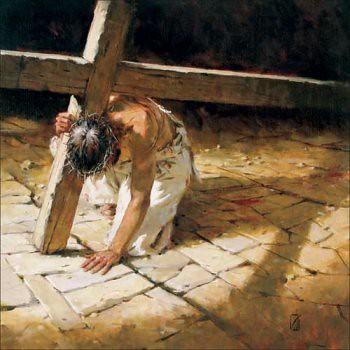
The Lord slowly stepped forward as the large wooden cross beam was placed upon his bruised shoulders. The sting of pain shot down his back as he bore the burden of the cross. As he began to walk the path that led through the city, he looked to the several women who had fallen to the ground by the overpowering of emotion. Step by step he carried his cross through the city until just before he reached the outer gates of the city where he fell to the ground. Exhaustion had over taken him and the loss of blood had exhumed his energy. The Roman soldier behind him cursed at him and brought his staff down upon his back with a crack! The pain was so intense that Jesus crumbled upon the stone walkway. “You! Carry his cross!” the Roman soldier yelled to an innocent onlooker. The man who had come from Cyrenian for the Passover looked in fear as he knelt down and took the cross beam from the Lord. Lifting it upon his shoulders he could feel the blood that had been on the cross drip down upon his back. He would carry the cross for a man he had never know; yet this Man knew his heart better than any other person on earth. This Man, though unable to carry his cross at this time, had born a burden far greater than a cross; he had carried the very weight of the world!

The day was Friday at about midday. Jesus had been condemned before the Jewish court, and then again condemned by the Roman government. According to Christian tradition, Jesus was then flogged 39 times; however, no evidence is given of the exact number in the gospels (see John 19:1). Whatever the case, though flogging could kill a man it was not designed to kill but to make the suffering on the cross all the more agonizing. Upon being flogged to the point that exhaustion and pain would almost overtake the body, Jesus then was commanded to carry His cross through the city (now traditionally marked in Jerusalem by the Via Dolorosa).

This Friday I had the opportunity to attend Catholic mass and then a Christian procession with some friends through Salt Lake City. As we began the procession we were asked at each of the seven stops “Who would carry the cross of Christ?” These words were very powerful as I thought of how Simon, though he was forced to carry the cross, symbolically took the place of each of us. In a sense, we each must ask ourselves if we would be willing to carry the cross. In fact before His death, the Lord commanded His disciples: “Whosoever will come after me, let him deny himself, and take up his cross, and follow me” (Mark 8:34). As I followed after those who were carrying the cross through the city, I thought of that day when His disciples had the choice to follow Him, even in death. I thought of what it must have been like to be there and see before you your Lord and Master carrying a cross that He did not deserve to carry.

For the Lord has truly carried our cross. He has carried our cross not only through the streets of Jerusalem, but He has carried it through a garden on the Mount of Olives. He has carried our cross into a dungeon filled with murders, through a trial where even those whom He would save would mock Him on every turn. He has carried it as He was bruised and scoured for our sakes. He has carried our cross as He looked into the eyes of His accusers not with hate, but with love unfeigned; enough love that He would even carry the cross for them. He carried the cross as He was hung on a tree only to be mocked and scorned by the very ones who would find access to His grace. Yet, all that He asks of us is to be willing to carry this cross that He for us has born. Not that we too shall suffer as He did, for He carried the cross for us that our burden may be light. He carried it so that when our cross is placed upon our bruised and weary shoulders, we may know that He stands by us to lift His back beneath the load that we might bear the weight more easily.

Thus, we each must ask ourselves, will I carry the cross I am called upon to bear? Will I follow the Lord in no matter what the circumstances may be? Will I look to Him that I may have my burden made light? Will I likewise help to make the load light for others? Will I turn away the weary, or will I put my shoulders beneath their loads that they might not falter? Will I lift those who may have fallen on their path to Calvary? Will I give relief to those who thirst as they trudge towards their hill of Golgotha? In short, will I follow the Savior and do His works?

April 9, 2009

The Holy Week: Part IV - Gethsemane


The night was dark and the air was crisp as Jesus and his disciples approached the temple mount from Mount Zion, where they had just partaken of the Passover feast. They had traveled this road many times, but this time Jesus led them through the temple courtyard on their way to the garden where Jesus loved to ponder and teach. As they walked through the large court of the gentiles towards the Golden Gate, Jesus looked upon the temple as if it were his last time he would see it. He loved this place, and his eyes now glistened as he stared up at the magnificent temple of God. The full moon shone upon the gold and shimmered in the night reflecting a beautiful glow across the entire court. They continued their walk and left the temple court walking through the gate and down the stairs that led to the bottom of the Kidron Valley and into the garden called Gethsemane. The old gnarled trees were in full bloom and the flowers were illuminated by the full moon above. The night was beautiful, yet Jesus seemed forlorn and weary. “How could he be so mournful on such a night as this?” thought Andrew as he walked beside his Lord and Master. Passover was considered by most, the greatest of all the feasts. As they entered the garden, opening the small wooden gate that creaked on its hinges, Jesus asked that only Peter, James and John come into the very midst of the garden. The rest of the apostles lied down near the outer wall to rest. As the four continued to walk past the large olive trees, a shadow seemed to cross the face of the Lord, a shadow that seemed to darken his very being. “Tarry ye here, and watch with me,” said the Lord with a heavy voice. He then continued into the very most center of the garden. As he fell to the ground, he winced out in pain. With sweat falling from his brow he looked to the sky. “Father, if it be possible, let this cup pass from me; nevertheless not as I will, but as thou wilt.” As the very weight of the world came upon him he wept. It seemed as though he, like the tender olive, was being crushed by the great weight that lie on his shoulders. After several hours, the Savior rose, wiping his blood speared face with his robe, and coming to the side of his three chief apostles. “Behold, the hour is at hand, and the Son of man is betrayed into the hands of sinners.” Upon hearing this, Peter looked into the face of the Master. Though he seemed to have stayed awake the entire night, a light emanated from his weary face. His eyes seemed to show more compassion and love as Peter had never seen before. Within himself Peter asked, “Why is this night different from all other nights?” Truly they had been spiritual slaves, yet on this night a new power seemed to be born; a power that would bring one at one with God. (See Matthew 26:36-45, Mark 14:34-42 and the Jewish Pesach Seder)

The atonement of the Savior is the most significant event to take place in all of history. While in a garden called Gethsemane, because of the large olive presses that were there in contained, the Savior knelt and ransomed man from sin and death. Gethsemane means “olive press” and thus was the tool used to make the freshly harvested olives into the life giving olive oil.

Olive oil for centuries was considered one of the most important substances for life in the Mediterranean. This rich golden oil was used to light the home of every family in Judea. Oil was also used to light the inner chamber of the Temple in Jerusalem. It was used to cook most food and in particular was used in the process of making bread, the very staff of life. Olive oil was also used to help create many ointments that were used for both the living—for healing purposes, and for the dead—to anoint the body prior to placing the body in the tomb. Even Jesus was anointed about a week before His death by Mary, the sister of Martha (see John 12:1-9), and then again after His brutal crucifixion by this and other faithful women (see Luke 24:1). Thus, it is highly significant that Jesus would chose to suffer and bleed in a garden of olive trees. He could have chosen any place to perform this sacrifice. Yet, He knew that by atoning for the sins of man within the gates of this garden, the meaning of His atoning sacrifice would be given a brighter light and imagery that would fill our lives for centuries to come; even into the eternities.

In the Gospel of John, Jesus Christ proclaimed “I am the light of world: he that followeth me shall not walk in darkness, but shall have the light of life” (John 8:12). We live in a world full of darkness and despair. We are surrounded by turmoil, financial crisis and by eroding values. We often feel that the path before us is dark and weary, yet if we will but only look to the Savior of the world, our path will be lighted, yea even to the overshadowing of all fear and gloom. As we learn to follow Him—which means we live as He did—we can take of His light that we may have no reason to fear.

The Lord also proclaimed “I am the bread of life: he that cometh to me shall never hunger; and he that believeth on me shall never thirst” (John 6:35). While in the garden of Gethsemane the Lord, through His infinite suffering, was empowered to provide eternal life to all mankind. Just as the Israelites in the days of old were fed from above by manna that came down to provide them with the very essence of life, so on this night of nights in a garden and later on the cross and then through the empty tomb, Christ has provided each of us with the very essence of life. Through His suffering we can overcome all suffering. Through his death we can overcome the chains of death. Through His life we can have even eternal life.

In addition, the Lord has stated: “Take my yoke upon you, and learn of me; for I am meek and lowly in heart: and ye shall find rest unto your souls. For my yoke is easy, and my burden is light” (Matthew 11:29-30). Through the atonement of Christ we can be consoled and healed of not only our spiritual, but our physical and mental pains. Just as olive oil was used in times of ancient to anoint the body to provide relief and comfort, so the atoning suffering of the Lord will bring relief and comfort to those in need. This relief will not only be provided in life, but in death. Truly, His life and teachings are as an ointment of power that is poured out upon our head and upon our soul that we may live forever more in peace.

As He knelt there alone in Gethsemane, He was literally weighted down, or pushed down upon by the sins and sorrows of the entire world. This burden, like the large stone that was placed upon the olives to squeeze out the precocious oils that they contained, likewise pressed upon His very soul that He bled from every pore (see Luke 22:42-44). The blood that He shed for our behalf, like the olive oil, gives light, life and comfort to our souls.

Because of what Jesus Christ did on our behalf while in this garden filled with olive trees, we have a light that will never be extinguished. We have a light that will enable us to enter back into the presence of the Father to pass by the angels and to enter into eternal life and exaltation. For truly, as Paul so eloquently stated, “Seeing then that we have a great high priest, that is passed into the heavens, Jesus the Son of God, let us hold fast our profession” (Hebrews 4:14). Let us each go forward with faith in our hearts, and the Light of the world as our guide that we too may enter into everlasting life.

April 8, 2009

The Holy Week: Part III - Passover


As the disciples sat on the ground surrounding the Master, they listened to him as he told the story of the first Passover night that took place almost 1500 years before. He told them of how Israel had been in bondage by the Egyptians and that on that night, because of the death of the first born son of Pharaoh, and the sacrifice of the lamb, that Israel would now be freed. He told them of how that after having sacrificed the lamb, they took of its blood and spread it upon the doorposts of each home as a token of protection. Then Jesus took the unleavened bread that had been prepared for the feast and broke it into pieces. “Take, eat; this is my body.” The disciples each stared in wonder as they each partook of the broken bread. Then Jesus took the cup of wine and said: “Drink ye all of it; For this is my blood of the new testament, which is shed for many for the remission of sins.” As Peter stared on in amazement he asked within himself “what is the meaning of this?” “What did the Master mean by saying this was his body and bread?” (see Matthew 26:26-28)

The day was Thursday, the first day of the Passover feast. As the evening approached Jesus and His disciples gathered in a large upper room on Mount Zion. The home most likely belonged to the mother of Mark (the gospel writer) who would be only a young man at this time. The gathering most likely consisted of not only the twelve disciples, but also other men and woman who had become followers of Christ as Passover was a time for the entire family. All of the preparations would have been made before hand and the table (most likely a triclinium, a low "U" shaped table) was set with all of the necessary elements for the Passover. It would include the sacrificed lamb, the maror (a combination of highly bitter herbs), the haroset (an apple mixture much like chunky apple sauce), the wine, and the unleavened bread.

The meal would start with a prayer after which the guests of the feast would partake of the first cup of wine called the “cup of blessing” (see Luke 22:15-18). The leader would then break a piece of the unleavened bread and hide it within a white cloth that would be passed around, later to be “redeemed” by the host (in this case Jesus). The story of the Passover would then be recounted as the participants would remember that night long ago when the Israelites were freed from their Egyptian captors. As a critical part of this recitation was the question that was asked by the youngest member of the group (possibly John the beloved): “Why is this night different from all other nights?” Whereupon the head of the home would tell the son that they were slaves in Egypt, but the Eternal Father brought them out by His outstretched arm. Jesus must have been filled with emotion beyond compare as He responded to this question; for truly on this night the true deliverance of all mankind would be accomplished.

Next, Jesus would explain the symbolism of each of the items found on the table. The lamb represented the unblemished lamb that had been slaughtered that they might be freed from the angel of death. The unleavened bread represented the swiftness of the flight for the Israelites, for they would not have time to use leaven or yeast in their bread as they left Egypt in haste. The bitter herbs were to represent the bitterness of bondage in Egypt. The apple mixture was to represent the mud made by the Israelites to create the wonders of Egypt.

Upon completing this explanation, the celebrants raised the second cup of wine (the “cup of remembrance”), blessed it and then drank of it. Then each partook of a piece of unleavened bread, bitter herbs and the apple mixture (if you have never eaten bitter herbs as part of a Passover, words cannot describe how horrendous this moment is). With the fumes of the bitter herbs in their mouth, the participants now would partake of the Passover dinner. It is significant that that which takes away the terrible aftertaste of the bitter herbs is that of partaking of the sacrificed lamb.

After the meal was complete the master of the table would then ask for the piece of bread to come forth that had been hidden. He would then “redeem” the piece by bargaining or purchasing it from the holder that all might partake of it. At this point Jesus then took of this piece of bread and said “Take, eat; this is my body” (see Matthew 26:26). It is highly significant that He would use the piece that was to be redeemed or purchased, for He who was the “bread of life” would redeem all that they might be able to partake of life eternal. The company then would bless and partake of the third cup of wine, called the “cup of redemption.” At this point, Jesus would take of the cup and say “this is my blood of the new testament, which is shed for many for the remission of sins” (see Matthew 26:28, Luke 22:20). Again, it is considerable that this third cup was called the “cup of redemption,” for truly it was through His blood that all would be redeemed.

The last part of the Passover meal was the partaking of the fourth and last cup of wine called the “cup of hope and freedom.” Jesus concluded the Passover meal by stating: “But I say unto you, I will not drink henceforth of this fruit of the vine, until that day when I drink it new with you in my Father’s kingdom” (see Matthew 26:29). Thus, Jesus tells his disciples that He will not partake of this last cup of “hope and freedom” until the second coming when the millennium will be ushered in and true hope and freedom will reign on earth.*

Each week as we partake of the sacrament we have the opportunity to participate in this symbolic ritual; a ritual that can teach us of true deliverance and of true hope. Each of us has sinned and has thus come short of the glory of God. We all are in spiritual bondage and are unable to free ourselves from these eternal chains. The only way we can be released is if we have the power of another who can reach down to us and raise us from our depths of sin and despair. Jesus Christ has come to earth to pull us from the depths of this captivity. He has given His life, being the firstborn of the Father, that we may each be freed. As we partake of the sacrament we remember the atonement of Christ, just as Jews remember, by the Passover meal, the captivity and the redemption of the early Israelites from Egypt. We remember that it was because Christ’s body was bruised and broken for our sakes that we are freed. Just as His body was broken, so is the bread broken and torn to represent His suffering. We remember His shed blood in Gethsemane and on Golgotha by partaking of the water or wine. As we partake of these emblems we literally make these elements a part of our body. Likewise, for the atonement to have full effect in our lives, we must make it part of us; we must allow the atonement to nourish and strengthen our very souls. As we learn to make His atonement a part of our soul and become at-one with Him, we will be freed from our spiritual and physical captors that hold us captive. I pray that on this holy day we may ponder and think of the sacrifice the Savior offered on our part that we might be freed. I pray that we each may become at-one with Christ through this supernal ordinance of the gospel.

*The above description is only a possible depiction of the Last Supper according to current Jewish Tradition on how the Passover is to be performed and the use of the four Gospels to fill in other missing information.

April 6, 2009

The Holy Week: A Fruitless Tree


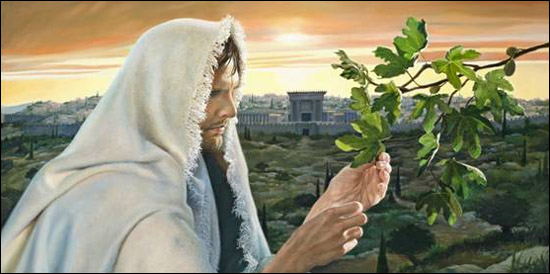
Jesus and his disciples walked along the dirt path that led from Bethany towards the temple mount in Jerusalem. As they walked they approached a large beautiful fig tree. They each were hungry, as they had not eaten much during that morning, as Jesus had wanted to arrive at the city as early as possible to be able to preach to the people in the city. Thus, as they neared the tree they had hoped that they would find a few figs that could provide them with some food. After all, the leaves had begun to come forth, meaning that the tree should have fruit. As they came to the tree Jesus reached forth his hand and combed through the branches, only to find leaves. With a glimmer in his eye Jesus said: “Let no fruit grow on thee henceforward forever!” The disciples looked on in disbelief by his words. Why would he curse the tree for such a simple thing? What was the meaning of such an act? (see Matthew 21:17-19)

The cursing of the fig tree took place most likely on Monday, the second day of Jesus’ Holy Week. The incident is often misunderstood or questioned, yet with the proper understanding of the context of the incident one can find beautiful meaning and depth. Directly following this account in Matthew, the Lord tells His disciples that they too can perform miraculous things as He had just done. “Verily I say unto you, If ye have faith, and doubt not, ye shall not only do this which is done to the fig tree, but also if ye shall say unto this mountain, Be thou removed, and be thou cast into the sea; it shall be done. And all things, whatsoever ye shall ask in prayer, believing, ye shall receive” (Matthew 21:21-22).

Immediately following this promised blessing to His disciples, Jesus is found in a confrontation with the chief priests as to His authority. As Jesus most likely sat under the large portico that surrounded the temple He asked them by what authority John the Baptist performed his work. They in turn could not reply, for by accepting John they would condemn their own authority (as they were supposed priests like unto John). By rejecting John they felt that they might offend those who listened, for most considered John to be a prophet. With this interchange, Jesus gave several parables that paralleled the lives of these chief priests.

The first parable tells of a man who had two sons and asked both to go do a work. The first said he would not but later did, while the second said he would and did not. Jesus then asked who was faithful to the father. Of course, these chief priests had been asked to do a work by the Eternal Father, even that of accepting and proclaiming the holy name of Jesus Christ. After all, this is what John did, and he was a priest like these men. However, they had said they would do his work, but then went and not only never fulfilled their word, but would soon go about to kill the very Son of God. (see Matthew 21:28-32)

The second parable that Jesus taught showed this exact sentiment. The parable teaches of a man who had a vineyard and had husbandman who were to care for it while he was away. When the time came to harvest, these men who were caring for the vineyard decided that they could profit from the earnings of the harvest by taking these profits unto themselves. When the master sent messengers to ask for a reporting, they stoned them, cast them out and rejected them. The master then thought that perhaps by sending his own son they would respond and give a reporting of their actions. However, these men seized the son and killed him that they might not have to deal with the master. Again, we can see a direct correlation to the fact that these chief priests had been entrusted with the temple and had been asked to keep it sacred and holy. However, they had not only polluted it, but they had used it as a means to earn profit by charging exorbitant fees for those who wished to exchange money and to buy animals for sacrifice. It was not that they were not permitted to do this, for it was highly difficult for a traveler to bring money that could be used in Jerusalem when each city had its own currency, and likewise hard to bring an animal that could be used for sacrifice on their long journey. However, it was the fact that they desired to make a profit on this that caused their condemnation. To further condemn them, within only a few short days these same men would seek the life of the Son, even the Son of the Eternal Father. (see Matthew 21:33-46)

The third parable Christ gives is in regards to a father who is to provide a marriage ceremony to his son. He in turn invites all of the people, and in particular the leaders of the community. However, when the men hear of the wedding, they turn down the invitation and say they have other tasks to complete. These men had been invited to partake of perhaps the most joyous and greatest event to ever take place upon the earth. Many have longed to live during the time of the Savior, to hear His words and to accept His light. Yet, we have not been blessed to live during His day, but these supposed “men of God” did live during His day. They were being asked to partake in the most glorious event of all eternity. However, they turned away the very man who would exalt and bless their lives forever more (see Matthew 22:1-14). According to Matthew, these men were very aware that Jesus was speaking of them, as they desired all the more to take away His life so that He would cease to threaten their power (see Matthew 21:45-46).

Thus, with this context we can understand that Jesus while cursing the fig tree spoke of these same men who should have born much fruit. They had been given great blessings and had thus been required to provide fruit to nourish and support the world with life eternal. These priests instead of providing life and vitality, they provided death and apostasy.

However, this is not where the parable ends, for each of us has been called to perform a work. We have been asked by the Master to follow Him. We have been asked to become like Him and to help others do likewise. How do we respond to this invitation? Do we say we will and then do not? Or do we say we will not and do?

We have each also been entrusted with a sacred temple of God, even our bodies. How do we use our bodies? Do we use them to earn money or to obtain wealth and prestige? Or do we use these same bodies to lift those in need and strengthen those whose knees quake? Do we use our voice to proclaim the word of God like unto John the Baptist? Do we use our hands to create works of art that will praise and proclaim the truth? Do we use our ears to listen to those in want? Do we use our feet to walk in His ways? Do we use our eyes to look for those whose heads hang low?

We likewise have been asked to participate in a glorious event, even that of the preparation of the Second Coming of the Lord and Savior. How will we respond to this invitation? Will we turn and find other compromises that may take our time away from the Lord? Do we spend hours watching television or wasting our time on the internet, or do we spend this same time in proclaiming and preparing the way for the Lord’s return? When the Lord returns will we be found ready and prepared to enter into His glory and rest? Will we wait with anxious anticipation for the time of His return? Will we glory in the time of His triumphal reentry into the world?

In short, when the Lord comes to us, will we be able to provide fruit that is precious beyond all else, or will we be like unto this barren fig tree that when given the opportunity to serve was found without? If we are found laden with fruit we will be able to perform all things as the Lord promised His disciples. “And all things, whatsoever ye shall ask in prayer, believing, ye shall receive!” (see Matthew 21:22). That we might be found worthy at that future day, laden with fruit and heavy with good works that glorify the Father and the Son is my prayer.

April 2, 2009

The Holy Week: Part I - The Triumphal Entry


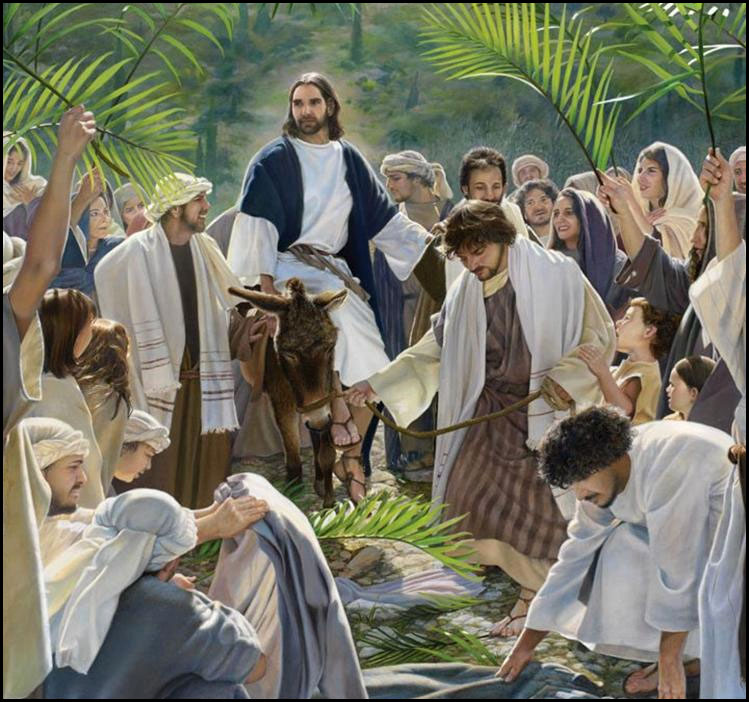
As the young colt walked slowly down the side of the Mount of Olives, the crowds began to gather in great numbers. Many had anticipated the coming of Jesus to the city of Jerusalem for the feast of Passover; for they had hopes that he was the promised Messiah. The Lord looked out over the masses that thronged the path that led to the Gate Beautiful and he smiled as he approached the large stone gate. Robes and branches had been strewn across his path that even the hoof of his animal might not touch the bare ground. As Jesus rode in the midst of the crowd they began to wave cut palm branches and shout “Hosanna to the Son of David.” The hundreds of waving branches appeared as an endless sea that swayed in the breeze. Little did they know that within the week this same Messiah would be scourged and crucified on a cross. (See John 12:12-15)

When Jesus entered Jerusalem a week before His crucifixion, He entered as a king and a ruler. The day was Sunday, the day after the Jewish Sabbath. Entering on a donkey, He rode as David and Solomon did of old. To enter on a horse would mean He entered as a conqueror, taking the city by force. Entering on a donkey meant he entered in peace, showing he would conquer all things not by compulsion or force, but by love and long suffering. Like this animal that only lived to serve its master, so Jesus only lived and died that we might have life. He, like this animal, submitted His will completely to the Father.

The waving of the palm branches, as part of the triumphal entry, and the shouting of hosanna is significant in that this same ritual was done during the Feast of Tabernacles. This feast, which is celebrated during the fall of each year, was to commemorate the wandering of Israel in the wilderness and the eventual entering into the Promised Land. Later, however, this feast also took on new meaning with the coronation of the kings of Israel, and the dedication of the Temple of Solomon (2 Chronicles 7:8-9).

Thus, Jesus was being welcomed as a King of Israel, the King of Kings, and the Lord of Lords. This act of worship by the Jews fulfilled the prophecy of Zechariah which stated: “Rejoice greatly, O daughter of Zion; shout, O daughter of Jerusalem: behold, thy King cometh unto thee: he is just, and having salvation; lowly, and riding upon an ass, and upon a colt the foal of an ass.” (Zechariah 9:9). The people were expecting a kingly messiah, and thus when Jesus allowed them to honor Him in this manner, they must have thought that He would free them from their Roman captors. However, they did not understand that though He would come as a political Messiah to free man from all earthly powers, He first would come to free them from a greater captivity of sin and death.

Often we are placed with the question that these Jews had to ask themselves. What type of Messiah are we waiting for? What type of freedom will he bring us? When we try to imagine up a god that does not truly represent the Lord, in essence we create our own god and place this personal creation above the true God of earth. When we do this, we lose sight of the true power and meaning of the atonement and thus lose access to His grace. For it is only after we understand who Christ is that we can practice faith in Him. For without a correct knowledge of God we cannot know what power He has, or what we can expect of Him. We cannot place faith in something we do not understand.

In regards to the dedication of the temple during the Feast of Tabernacles, it is significant that on this same day, Jesus would come into the temple and cleanse it, and make it His own. Thus, He would be welcomed into the city as King, and then come into His house and cleanse it and sanctify it for His work. We likewise, must allow the Savior to come into our lives and cleanse our “temples” of all that is impure. If we resent His actions, like those of the Jewish leadership, we too will have our “temples” destroyed and burned. If we, like the disciples, allow Him to cleanse us and make us pure, we will become great men and women who can literally change the course of mankind.

Each of us has the opportunity to accept or reject the Messiah. We can welcome Him with praises of Hosanna, with lying down of our all before Him, or we can reject His teachings and strive to thwart His mission. By learning to follow Him and learn of His true mission, attributes and power, we are enabled to gain His same power and then become at-one with Him. Only then can the atonement of Christ cleanses us and purify us, only then can we be whole.

March 31, 2009

The Holy Week: Introduction


The Holy Week is the most significant period of time in all of history. During this single week, all of mankind was freed from the cold chains of death and enabled to overcome all things, including sin. During this week, we learn more of the Savior and of His true attributes than during any other period of His life. Though He was born of miraculous circumstances, though He healed the sick and raised the dead, yet no other event in His life stands in comparison to His atoning sacrifice that he performed during this week of weeks. Thus, with this in mind the next several blog posts will be devoted to this Holy Week and how we can learn more of the Savior and become better followers of Him through the study of the Holy Week.