Showing posts with label Atonement. Show all posts

September 27, 2020

Understanding the Day of Atonement or Yom Kippur


The Day of Atonement, or Yom Kippur, is the most holy and solemn day of the Jewish calendar. It is the only day when the high priest could enter the Holy of Holies, the most sacred place within the Tabernacle and ancient temples. It was the only day when the high priest reconciled Israel with God and symbolically brought them back into the presence of the Lord. No other day and no other ancient ritual comes closer to the full meaning and purpose of the atonement of Jesus Christ.

The fall season of festivals begins with Rosh Hashana, the beginning of the Jewish New Year. Rosh Hashana marks the start of a ten-day period of repentance and preparation for the Day of Atonement. During these ten days, Israelites would seek to draw closer to God in preparation for these sacred rituals. On the Day of Atonement, all of Israel would be forgiven for their sins of the previous year, thus allowing them to be cleansed and prepared for the Feast of Tabernacles or Sukkot to occur five days later. Feast of Tabernacles was the final and most joyous of the three major Jewish feasts of Passover, Pentecost, and Tabernacles.

The Day of Atonement followed a complex, yet beautiful ritual, symbolizing that all of Israel now had been forgiven and was able to re-enter the presence of the Lord through the high priest (see Leviticus 16).

The ritual began with the high priest, dressed in his normal colorful golden garments, offering the daily morning ritual of sacrifices and burning of incense on the altar of incense. He then would wash his flesh and change into simple white robes. The act of washing and changing clothes would actually occur five separate times throughout the ritual. The wearing of just the white robes could symbolize the Savior who leaving His heavenly throne, “laid aside all the glory … [and] put upon Himself the plain robe of humanity … becoming like one of us.” [1] The color of white is also a powerful symbol of purity, representing the absolute purity of the true Great High Priest, even Jesus Christ.

The high priest selecting lots for the goat for the Lord and for the scapegoat
Next, the high priest would bring two goats into the Tabernacle or temple and cast lots for each of them. One lot was for Azazel, or the scapegoat, and the other was for the Lord (Leviticus 16:7-10). A red ribbon was tied around the horns of the scapegoat to distinguish it from the other goat.

The high priest would then take a bullock, or young bull and place his hands on its head, symbolically transferring his own sins and the sins of his fellow priests to the bull. He would then slit the throat of the bull and catch the blood in a dish to be saved for later services. (Leviticus 16:11)

The high priest entering the Holy of Holies with incense on the Day of Atonement
He then would bring a burning coal from the altar of sacrifice and incense into the Holy of Holies through the veil for the first time. Here dressed in all white, the high priest would burn the incense before the Lord. The room would fill with smoke, the cloud of smoke often being a symbol of the presence of God. (Leviticus 16:12-13).

The high priest then would exit the Holy of Holies, wash again, and take the blood of the bull and re-enter the Holy of Holies for a second time. He would then sprinkle seven times the blood of the bull on the Ark of the Covenant. (Leviticus 16:14). The shedding of the blood of the young bull represented that the high priest was forgiven and reconciled to enter into the presence of the Lord.

The high priest entering the Holy of Holies on the Day of Atonement
The high priest would then kill the goat that was chosen for the Lord, again saving the blood in a dish. He then would enter the Holy of Holies with this blood for the third and final time. As he did before, he would sprinkle the blood of the goat seven times before the ark. (Leviticus 16:15-16). As the goat was the offering for the people, this act of bringing its blood into the Holy of Holies represented that all of Israel was symbolically able to enter the presence of the Lord, through the high priest and because of the shedding of the blood of the sacrifice. Just as the high priest could only enter by blood, so too it is only by the shed blood of Jesus Christ that we can enter God’s presence.

As the high priest exited the Holy of Holies, he would then sprinkle the combined blood of the bull and the goat before the veil of the Tabernacle. He would also use the blood to cover the four horns of the altar of incense. The remaining blood was poured out at the base of the altar of sacrifice in the outer court. (Leviticus 16:18-20).

High priest laying his hands on the scapegoat for the Day of Atonement
The high priest would then return to the scapegoat and place his hands upon its head symbolically transferring the sins of all the people to the goat. He then would utter the sacred name of the Lord, which was never to be said except on this holy day, “Oh, Jehovah! I intreat Thee! Your people, the House of Israel, has been iniquitous, sinned, and erred before you. Oh, then Jehovah! Cover over, I intreat Thee, upon their iniquities, their transgressions, and their sins!” [2] The goat was then taken outside of the Tabernacle and led into the wilderness. (Leviticus 16:20-21). The guiltless goat, dependent upon its owner for its care and protection, would become lost and die in the desert. Perhaps no symbol of the Savior is more powerful than the scapegoat. Innocent of any wrongdoing, just like this goat, the Savior has had laid upon Him the sins of the world. As Isaiah so beautifully stated, “All we like sheep have gone astray; We have turned, every one, to his own way; And the LORD has laid on Him the iniquity of us all.” (Isaiah 53:6).

The scapegoat being led into the wilderness on the Day of Atonement
Modern readers often gloss over the significance of the Day of Atonement as simply an outdated, archaic ritual of death and covering of blood. However, as one better understands each of the aspects, it teaches a powerful message of the atonement of Jesus Christ.

The word atonement, or kaphar in Hebrew, actually means to cover. Thus, as the high priest literally covers with blood the ark, the veil, and the altars of the Tabernacle, he symbolically shows that atonement has been made, and that the way is now open to progress back through the Tabernacle because of the shedding of blood.

From the scriptures we learn that when the Savior went to pray and suffer in Gethsemane, He first left eight disciples at the entrance, then took Peter, James, and John further into the garden, and then by Himself, went further in to pray. Though it is impossible to know the exact reason for this three-level progression the Savior creates within the garden, it has a strong correlation to the three levels of the Tabernacle with the outer courtyard, the holy place, and the holy of holies. It is as if the Savior desired to recreate these three levels, to show that He was officiating as our Great High Priest and interceding on our behalf.

How beautifully the symbolism of the Day of Atonement teaches us that it is only through the shed blood of the Lamb of God, even Jesus Christ, that we can once again enter the presence of the Lord. It is only because He took upon Himself our sins and iniquities, that we can be forgiven and our burdens made light. Because of Him, we can have our sins covered over, blotted out, or atoned for. The book of Hebrews teaches, “But Christ being come an high priest … Not with the blood of goats and calves, but with His own blood He entered the Most Holy Place once for all, having obtained eternal redemption” (Hebrews 9:12). How wonderful it is that unlike ancient Israel, who only could be forgiven once a year, we can daily come to the Lord, lay our sins and guilt upon Him, and continually be forgiven and cleansed because of His atonement!


[1] Thus Shalt Thou Serve, The Feasts and Offerings of Ancient Israel, C.W. Slemming, pg. 151.
[2] Paraphrased from: The Temple, Its Ministry and Services by Aldred Edersheim, pg. 253-254 and Carta's Illustrated Encyclopedia of the Holy Temple in Jerusalem by Israel Ariel, pg. 146-147.

October 20, 2019

The Laver and the Washing and Anointing of Priests


Within the outer courtyard of the Tabernacle of Moses was the bronze laver (see Exodus 30:17-21). It was here at the laver where Aaron and his sons were washed, clothed, and anointed prior to becoming a priest. The laver was also used by the priests for daily ritual washing prior to serving at the Tabernacle. The washing at the laver can symbolize our need to be spiritually cleansed through the atonement of Jesus Christ.

Only the tribe of Levi, and in particular the family of Aaron, could officiate at the Tabernacle; therefore, the Lord commanded that Moses first consecrate them for this sacred service here at the laver. In Exodus 40 it reads, “And thou shalt bring Aaron and his sons unto the door of the tabernacle of the congregation, and wash them with water. And thou shalt put upon Aaron the holy garments, and anoint him, and sanctify him; that he may minister unto me in the priest's office.” (Exodus 40:12-13). This consecration of the priests included three important and symbolic acts: washing, clothing, and anointing. These gestures were to demonstrate and teach Israel that the priests were authorized to act on their behalf.

In ancient times, washing with water often symbolled becoming ritually clean, allowing the person to perform sacred acts such as prayer or sacrifice. Though we are not given any details about the washing process, many scholars speculate that it would include the washing of the full body. [1] The scriptures include many references to ritual washing including one from Psalms “Wash me throughly from mine iniquity, and cleanse me from my sin” (Psalms 51:2).

After the washing with water, the high priest and priests were clothed with the holy garments. Unlike today, clothing in ancient times was very costly and difficult to make. The hand spinning and looming process could take possibly hundreds of hours for a single piece of clothing. Thus, the giving of clothing, especially ceremonial clothing, represented a significant bestowing of authority and power. Interestingly the word atonement in Hebrew, or kaphar, actually means to cover, possibly connecting the sacred priestly clothing, which covered the priests, with the atonement of Jesus Christ.

Moses anointing Aaron with oil, the oil is stored in the horn of a bull
Next, Moses was to anoint Aaron and his sons with sacred anointing oil and blood from the sacrifice. The oil was a special combination of pure olive oil with liquified myrrh and other spices (see Exodus 30:22-30). Several stories in the Bible state that anointing oil was stored in an animal’s horn (see for example 1 Samuel 16:13 and 1 Kings 1:39), the horn often being a symbol of power and strength. [2] The scriptures again do not provide any details how the priests were anointed with oil, but we are told about the process of anointing with blood which may give us hints to the full process. [3] Moses would first kill a ram and then save the blood in a dish. He would then place the blood on the right ear of the priest, then on his right thumb, and then the right toe of his foot. (Exodus 29:20 and Leviticus 8:23-24).

Moses dabbing blood on the right ear of Aaron
Blood being placed on the right thumb of Aaron
Moses placing blood on the right toe of Aaron
This act of covering with blood certain parts of the body might seem strange to modern readers of the Bible, but understanding its significance can help us learn several powerful lessons. First, again the meaning of the word atonement in Hebrew means to cover. Second, each of the body parts could represent the service at the Tabernacle and to the Lord. The ear can symbolize the need to hear and follow the word of God. The thumb can represent our actions and ability to labor in the work of the Lord. The toe often is a symbol of our daily walk possibly teaching the priests that they were to walk in the paths of righteousness. By anointing with blood these parts of the body, it could serve as a reminder to the priests that all their actions and deeds should bring others to the Lord. According to one scholar, it could also symbolize that the priest, who represented Israel, was taking upon him the tokens of the death of the sacrifice. Thus, reminding him that it is only by the blood of the sacrifice that he is worthy and able to enter the Lord’s presence. [4]

After being consecrated just once in their life before becoming a priest, the priests then would ritually wash their hands and feet daily at the laver before performing sacrifices and entering the Holy Place (Exodus 30:19-21). This served as a constant reminder that they were to be spiritually clean prior to coming before the Lord.

The priest ritually washing his hands at the laver
After completing these sacred cleansing rituals, the priests were authorized to serve at the Tabernacle and in particular, enter the presence of the Lord into the Holy Place, and in the case of the high priest, the Holy of Holies on the Day of Atonement. Though Israel would not participate in these sacred cleansing acts individually, the priests represented them all as if they too were able to be washed themselves. This would hopefully be a reminder to ancient Israel that as they watched the priest physically and spiritually prepare to act on their behalf, they knew they likewise had to be prepared to enter albeit symbolically through the services of the priests.

These powerful symbolic acts at the laver can teach us of our own need to be cleansed by the waters of baptism, clothed in the power of the atonement, and anointed by the blood of the Lamb of God having our sins covered over or blotted out. These rituals can be an outward representation of the truth that it is only through the atoning power of the Savior that we can ultimately be worthy and able to enter the presence of the Lord!


[1] The Gate of Heaven, by Matthew B. Brown, pg. 79.
[2] The Lost Language of Symbolism, by Alonzo Gaskill, pg. 49-50.
[3] The Gate of Heaven, pg. 79-80.
[4] The Anchor Bible, Exodus 19-40, by William H. C. Propp, pg. 530-531.

June 17, 2019

Holy Week: His Blood Be On Us


After the Savior was judged by Pontius Pilate within the confines of the palace of Herod, Pilate again brought Jesus before the Jewish leaders. Here Pilate exclaimed that he had found no fault with Jesus and sought to release him because of His innocence, symbolically washing his hands of the matter. The most vocal of the crowd would hear nothing of Pilate’s verdict of innocence for the Lord. The Gospel of Matthew records the profound interchange: "When Pilate saw that he could prevail nothing, but that rather a tumult was made, he took water, and washed his hands before the multitude, saying, I am innocent of the blood of this just person: see ye to it. Then answered all the people, and said, His blood be on us, and on our children." (Matthew 27:24-25).

Here among the group were many of the priests of the temple, including the high priest himself who well understood the concept of a blood atonement. The word atone, or khapper in Hebrew means to cover, blot out, expiate, condone or cancel. For the priests, this term of atonement or covering also had a literal application during temple sacrifices. Depending on the type of sacrifice that the priest was offering, a portion of the blood of the animal was dabbed upon the horns of the altar, splashed against the sides, or poured out at the base. On the Day of Atonement (the holiest day of the year), the High priest would, in addition, dab blood on the horns of the altar of incense, and sprinkle blood before the veil. The High Priest would also enter the Holy of Holies and with blood from the sacrifice sprinkle it seven times upon the Ark of the Covenant. This “covering” with blood of the various pieces of furniture within the Tabernacle and later temples represented that the blood of the sacrifice covered, or made atonement for the sins of all Israel. Because of these rituals, the act of covering with blood, and atonement were almost interchangeable for the Israelite people.

How ironic that here the people ask that Christ’s blood be upon them. Of course, the Jewish leaders did not mean to imply that Jesus’ blood would atone for them, or cover them, but the symbolism of the wording they choose still vividly remains. How true their request would be that the blood of the Lamb of God, who would be slain for their sins, would come upon them or cover them; for Christ did suffer for all, even His accusers. Even more powerful is the statement that Christ’s blood be upon their children, for all, both Jew and Gentile, are to be grafted into the lineage of Abraham, thus becoming children of Abraham, Isaac, and Jacob.

Each of us, in essence, are part of the crowd who requested that Jesus' blood cover them. As sinners we each have the need of having our sins blotted out, or covered over to be remembered no more by God. Truly, it is by His blood coming upon us that we are forgiven. How prophetic the words of these wicked men, who in attempting to place blame on their children, actually helped in providing the means of salvation to their children through the blood of the Lamb of God. The Lamb, that on their behalf, and by their request, was slain!

April 11, 2018

The Tabernacle and the Messiah


Throughout history, the Lord has commanded His people to build temples. A temple is a place where holy ceremonies and ordinances are performed. It is a place where the Lord has revealed Himself and instruction is given to help the sons and daughters of God gain eternal life. It is literally a House of the Lord.

At the time of Jesus Christ, the Temple of Herod at Jerusalem was the center of religious life and learning for the Jews. A thousand years before the Savior, Solomon's Temple was the crown jewel of Israel's greatest age. But even Solomon's Temple was modeled after another. By going further back in time to the days of Moses, we can see a type of portable temple used by the children of Israel in the wilderness: the Tabernacle.

The Tabernacle, like the temples that followed it, was the place where the children of Israel learned the way to eternal life. Let's take a tour of the Tabernacle and see what we can learn. This gate in the east wall is the only entrance and leads to the outer courtyard. This courtyard might represent the telestial world we live in. Within the outer courtyard and in front of the tent of the Tabernacle are the Altar of Sacrifice and the Laver.


The Altar of Sacrifice is where burnt offerings were made to the Lord, symbolizing the suffering and death of the Savior on the cross. Here at the altar, Israelites made offerings that represented their faith in Jesus Christ. Through repentance, symbolized by their offering the animal to God, and their life and obedience, they would prepare for the cleaning power of the Holy Spirit.

The Laver is made of brass and contains water. Officiating priests were required to ritually wash here before entering the tent of the Tabernacle. The Laver represents the need for washing and cleansing of souls from sin, and could represent the waters of baptism.


The tent of the Tabernacle is made up of two rooms. The first room, called the Holy Place, contains the candlestick or Menorah, the Altar of Incense, and the Table of Showbread. This Holy Place might be seen as the terrestrial world, and taught Israel how to be in the world but not of the world. The Menorah provided light for the Holy Place and was kept constantly burning. It symbolizes the Holy Ghost and emphasizes the need to live by the light of the Spirit in this life.

On the Table of Showbread was kept 12 loaves of unleavened bread, which were eaten by the priests every Sabbath. Jewish tradition holds that a pitcher of wine was also kept on the table. The bread and wine on the Table of Showbread reminds us of the bread and water of the Sacrament. It suggests the Savior's sacrifice for us as well as the need to be spiritually nourished by Him.

The Altar of Incense sits in front of the entrance to the Holy of Holies. Each morning and evening, the High Priest burned incense here. Incense is a symbol of prayer, just as the smoke from the altar rose before the veil every morning and evening, so Israel was expected to raise their prayers regularly before the Lord. The altar's position before the Holy of Holies also shows the importance of prayer in preparing to enter the Lord's presence. The linen veil separates the Holy Place from the Holy of Holies. Embroidered on the veil are figures called cherubim, which symbolically guard the presence of God.


We now enter the Holy of Holies. The Holy of Holies represented our ultimate goal of living in the very presence of the Lord in the celestial world. The High Priest entered this room only once a year on the Day of Atonement. In the center is the Ark of the Covenant, the most sacred object in the Tabernacle. Inside the Ark are kept other sacred objects, including Aaron's rod, a bowl of manna, and the stone tablets of the Law given to Moses on Mount Sinai. The tablets reminded Israel that their return to the presence of God was based on their obedience to His laws and ordinances.

The lid is called the mercy seat, or seat of Atonement. It is made from pure gold and features two cherubim. On the Day of Atonement, when the High Priest entered the Holy of Holies, he sprinkled blood from the Sacrifice on the mercy seat as part of the ceremony, symbolizing that through the blood of the Lamb of God, Israel obtained mercy and the opportunity to once again live in God's presence.

The Tabernacle and its furnishings showed Israel the path that leads back to our Father in Heaven. The outer courtyard represents coming to the Savior from out of the world. The Holy Place represents living by the Spirit in this fallen world. The Holy of Holies and the Ark of the Covenant remind us that, through the atonement of the Lord Jesus Christ and obedience to His covenants, we can return to the very presence of our Father in Heaven.

Text modified from the video The Tabernacle.

March 28, 2018

The Last Supper and the Passover Feast


Each year, Christians throughout the world celebrate Holy Week, the most significant period in the Christian calendar. Holy Week commemorates the last week of the life of Jesus Christ, his crucifixion and his resurrection from the tomb.

During this same time each year, Jews around the world celebrate Passover, the most significant festival in the Jewish calendar. The Jewish holiday of Passover commemorates the redemption of the ancient Israelites from bondage in Egypt after being slaves for 300 years.

The Bible records the Lord’s command to celebrate the first Passover: "And the Lord spake unto Moses and Aaron in the land of Egypt, saying, Speak ye unto all the congregation of Israel, saying, In the tenth day of this month they shall take to them every man a lamb...without blemish, a male of the first year…and the whole assembly of the congregation of Israel shall kill it in the evening. And they shall take of the blood, and strike it on the door post of the houses, wherein they shall eat it. And they shall eat the flesh in that night, roast with fire, and unleavened bread; and with bitter herbs they shall eat it....For I will pass through the land of Egypt this night, and will smite all the firstborn in the land of Egypt, And the blood shall be to you for a token upon the houses where ye are: and when I see the blood, I will pass over you, and the plague shall not destroy you, when I smite the land of Egypt." (see Exodus 12:1-13)

For 3,500 years Jews have celebrated Passover, and have used the symbolism of the meal to remember the captivity and redemption of their fathers, and to look forward to the Messianic age and their own final redemption.

The Betrayal by Marilyn Todd-Daniels
Jesus, himself a Jew, likewise used the symbolism of the Passover meal to teach His disciples about His mission, as He prepared them to understand the spiritual redemption that would come from his suffering and death. Just as the blood of the Passover lamb on the doorposts of the homes of faithful Israelites had saved them from the power of the destroying angel, so the blood of the lamb of God, shed for all on Calvary’s cross, would save all who would come unto Christ from the power of sin and death.

Though it is difficult to know exactly how the Last Supper took place, the gospel writers refer to several Passover symbols during the meal and discourse that followed. Understanding this sacred holiday in its Jewish context will help us appreciate the Last Supper and the Savior's redemption on this Passover night.


Tradition tells us that the day was Thursday, the first day of the Passover feast. As the evening approached, Jesus and His disciples gathered in a large upper room on Mount Zion in Jerusalem. His disciples had made preparations beforehand and the table was set with all of the necessary elements for the Passover.

According to Jewish tradition, a roasted lamb would be served as the main dish, in remembrance of the blood of the lamb on the doorposts of the homes, which protected their ancestors from the destroying angel. Alongside it, bitter herbs, representing the bitterness of slavery, and a mixture of chopped apples and nuts, called haroset, representing the mortar used by slaves to build the wonders of Egypt. Salt water was used to recall the salty tears shed by the Israelites in slavery. Into the salt water they dipped greens, such as parsley, representing springtime, the season of Passover, the season of hope.

Passover symbols: haroset, salt water, parsley, wine, and bitter herbs
Central to the Passover feast was the unleavened bread, or matza, which reminded the disciples of the haste with which Israel left Egypt--their ancestors not having even enough time to allow their bread to rise. This was the bread which Christ blessed and broke and gave to his disciples, saying, “Take, eat, this is my body which is broken for you, this do in remembrance of me” (1 Corinthians 11:24).

“After the same manner also he took the cup...saying, This cup is the new testament in my blood: this do...in remembrance of me” (1 Corinthians 11:25). In instituting this sacramental emblem, Jesus used one of the four cups of wine which was consumed during each Passover meal, each cup representing a unique aspect of God’s promise to redeem Israel.

During the meal, the question was asked by the youngest member: “Why is this night different from all other nights?” Whereupon, the story of the redemption of Israel from captivity was told. Passover is different from all other nights, but this Passover night was truly different, for on this night, Christ would redeem all His children from the slavery of sin, and the bondage of death.

After completing this symbolic meal “And when they had sung a hymn, [Jesus and his disciples] went out into the mount of Olives” into a garden called Gethsemane (Matthew 26:30). Jesus’ atoning journey had begun. The true Passover Lamb had come.

The text of this script comes from a  youtube video I produced back in 2011 with the help of Amy Grigg. With over 8,000 views I decided to update the video to HD and widescreen.

June 4, 2015

Jesus Christ The Great High Priest


One of the many titles given to Jesus Christ is that of the Great High Priest (see Hebrews 5). To understand this Messianic title, we first must understand the role and significance of the High Priest in ancient times. During the exodus, as the Israelites were camped at the base of Mount Sinai, the Lord desired that all his children be able to enter into his presence within the walls of the Temple or Tabernacle. However, because of their sinfulness in creating a golden calf, God instead had the High Priest take the place of Israel, becoming the intercessory on their behalf. To help symbolize his important role as a mediator and as a type of Christ, each piece of the clothing of the High Priest pointed to the Messiah.

"The high priest wore eight holy garments. Of these, four were of the same type worn by all priests, and four were unique to the High Priest." [1]

The four garments worn by all priests were, first, the priestly undergarments or breeches. These linen pants were made to "cover the nakedness" of the priests and covered them from the waist to the knees (Exodus 28:42). Second, was the priestly tunic or robe, which was likewise made of white linen, was seamless, and covered most of the body of the priest (Exodus 28:39-40). Third, was the priestly sash, made of white linen for the normal priest, and an embroidered sash made of gold, blue, purple, scarlet, and white for the High Priest, and was used as a type of belt around the tunic or robe. Fourth, is the priestly turban, bonnet, or cap, which was a long strip of white linen wrapped around the head of the priest.

The blue robe with alternating golden bells and pomegranate-shaped tassels  
The four golden garments worn by only the High Priest were, first the priestly blue robe, which was a sleeveless and seamless robe that was about a hand breadth shorter than the white full-length robe. On the bottom of the blue robe were alternating golden bells and pomegranate-shaped tassels made of blue, purple, and scarlet wool. Second, was the ephod, "a richly embroidered vest or apron with two onyx engraved gemstones on the shoulders, on which were engraved the names of the tribes of Israel." [2] Third, was the breastplate, which had twelve different stones in gold settings, fastened to the breastplate, each engraved with one of the names of the tribes of Israel. The breastplate was folded in half to create a pocket where the Urim and Thummim was stored. The fabric for both the ephod and the breastplate were woven from gold thread, blue, purple, and scarlet wool, and white linen. The breastplate was fastened on the top by gold-twisted chains attached to the two shoulder stones, and on the bottom by blue ribbons tied to the ephod. The last of the golden garments of the High Priest was the crown, worn over the front of the turban and attached to the forehead by two blue ribbons, the crown being inscribed with the words "Holiness to the Lord" (Exodus 28:36-38).

The white robe and turban used by all priests
Each of the pieces of clothing, including their materials and colors, pointed to Jesus the Messiah, the Great High Priest. First, we'll discuss the four white linen vestments. White in the Bible represents purity, while the Hebrew word that was often used for linen means 'separation.' [3] Purity and separation from the world are both perfect symbols of the life of Christ. [4] John, remembering the white seamless robe worn by the priests, tells us that at the cross Jesus likewise wore a seamless robe (see John 19:23).

On the blue outer robe were attached alternating bells and pomegranate tassels. As the High Priest would walk around the bells would ring, reminding everyone around him, that they were in the presence of the High Priest, the representative of the Lord. The pomegranate in the scriptures represents fruitfulness, posterity, and prosperity, as there are literally hundreds of seeds in a single fruit. It is through the atonement of the Messiah that we are all made children of Christ, and heirs of his kingdom.

"In the scriptures ... the forehead represents what a person’s thoughts dwell on and therefore what he loves or desires. ... For the same reason, the Mosaic high priest wore an engraved gold signet on his forehead that read ‘Holiness to the Lord’ (see Exodus 28:36-38). This was a reminder that his thoughts should always be holy, with the result that his actions would follow suit." [5]

The clothing of the High Priest
Perhaps the most significant and expensive part of the High Priest's clothing was the ephod and the breastplate. According to the Bible, the stones on the two shoulders, engraved with the twelve tribes of Israel, were to represent that the High Priest was to symbolically bear or carry Israel upon his shoulders at all times. The twelve stones on the breastplate, likewise, represented that he was to carry Israel against his heart (see Exodus 28:12, 29-30). As Christ atoned in the Garden of Gethsemane, and died on the cross of Calvary he literally carried all of the world on his shoulders and against his heart.

Close-up of the breastplate showing the five colors
The blue robe, the ephod and the breastplate were all made of linen and wool, and of the same five colors; gold, blue, purple, scarlet, and white. Linen again represents 'separation' from the world, while wool can be connected to the sheep that were used in so many of the temple sacrifices.

Gold in the scriptures represents wealth, power, the celestial realm, and the divine. [6] Blue represents all things heavenly, being the color of the sky. The priest's outer robe being entirely blue "emphasized the fact that his authority was of heavenly origin and his life was the typifying of God and Christ." [7] The color purple represents royalty, power, wealth, and majesty. Producing purple dye in ancient times was extremely costly and difficult, meaning that only the wealthiest could afford to wear the color purple. [8] It is interesting to note that Christ, according to Mark and John, was clothed in a purple robe by the soldiers before his crucifixion in an effort to mock him as the King of the Jews (see Mark 15:17 and John 19:2-3). The color scarlet, or red represents sin, mortality, death and resurrection. [9] In the same account of the mocking soldiers, Matthew tells us that the robe was scarlet (see Matthew 27:28). In addition, the book of Revelation depicts Christ at His Second Coming wearing a robe dipped in blood, making it the color red (see Revelation 19:13). As was already mentioned, white represents purity and typifies the type of life that Christ lived.
The breastplate of the High Priest
Just as the five colors were fully interwoven and united into one single piece of cloth, so too the attributes of Christ (typified by each of the colors), were combined into one, to demonstrate the saving grace of Christ, the number five representing God's grace in the scriptures. [10] Each attribute on its own is powerful, but only when they are all interwoven together is the true power of the atonement realized. The fact that the twelve precious stones, representing Israel, were fastened to the breastplate, which symbolizing the attributes of Christ, teaches us that we, as Israel, are each bound to Christ and made one with him because of his perfect life and infinite atonement.

As Paul wrote, "Seeing then that we have a great high priest, that is passed into the heavens, Jesus the Son of God, let us hold fast our profession. For we have not an high priest which cannot be touched with the feeling of our infirmities; but was in all points tempted like as we are, yet without sin. Let us therefore come boldly unto the throne of grace, that we may obtain mercy, and find grace to help in time of need." (Hebrews 4:14-16). [11]

[1] High Priest of Israel, Wikipedia
[2] High Priest of Israel, Wikipedia
[3] Linen, BibleStudyTools.com
[4] Revelation 15:6 speaks of the seven angels being likewise clothed in white linen
[5] The Lost Language of Symbolism, by Alonzo L. Gaskill, page 39 (see Forehead)
[6] The Lost Language of Symbolism, page 91-93 (see Gold)
[7] The Lost Language of Symbolism, page 89-90 (see Blue)
[8] The Lost Language of Symbolism, page 96-99 (see Purple), also see Esther 6:7-8, 8:15 when Mordecai is dressed in a purple robe to represent the royal favor of the king.
[9] The Lost Language of Symbolism, page 99-102 (see Red/Scarlet)
[10] The number 5, The Bible Study Site
[11] The book of Hebrews mentions the term 'high priest' 20 times, and is by far the best scriptural source for teaching about the relationship between the High Priest and Jesus Christ.

April 2, 2015

Holy Week: Gethsemane and the Olive Press


After the Savior had finished the Last Supper with his disciples, which was probably around 10 pm on Thursday night, the Lord took His disciples down the Kidron Valley and then up the Mount of Olives. Only five days previous, on what we now call Palm Sunday, the Savior had come down this same mount to the shouts of praise by the Jews who hailed Him as King of kings, as the anointed Messiah. Yet, now He went with no fanfare into a garden where He would take upon Him the sins of the world.

Gethsemane comes from the Hebrew words 'gath' meaning press, and 'shemen' meaning oil. The fact that Christ chose a garden called Gethsemane is significant for many reasons. Olive oil was considered one of the most important substances for life. This rich golden oil was used to light the home of every family in Judea. Oil was also used to light the inner chamber of the Temple in Jerusalem. It was used to cook most food and in particular was used in the process of making bread, the very staff of life. Olive oil was also used to help create many ointments that were used for both the living, for healing purposes, and for the dead, to anoint the body prior to placing it in the tomb. Oil was also used to anoint kings, priests, and prophets. In short, olive oil played a central part of Jewish religious and daily life.

Iron age courtyard with olive press (from Atlas of the Bible, page 80)
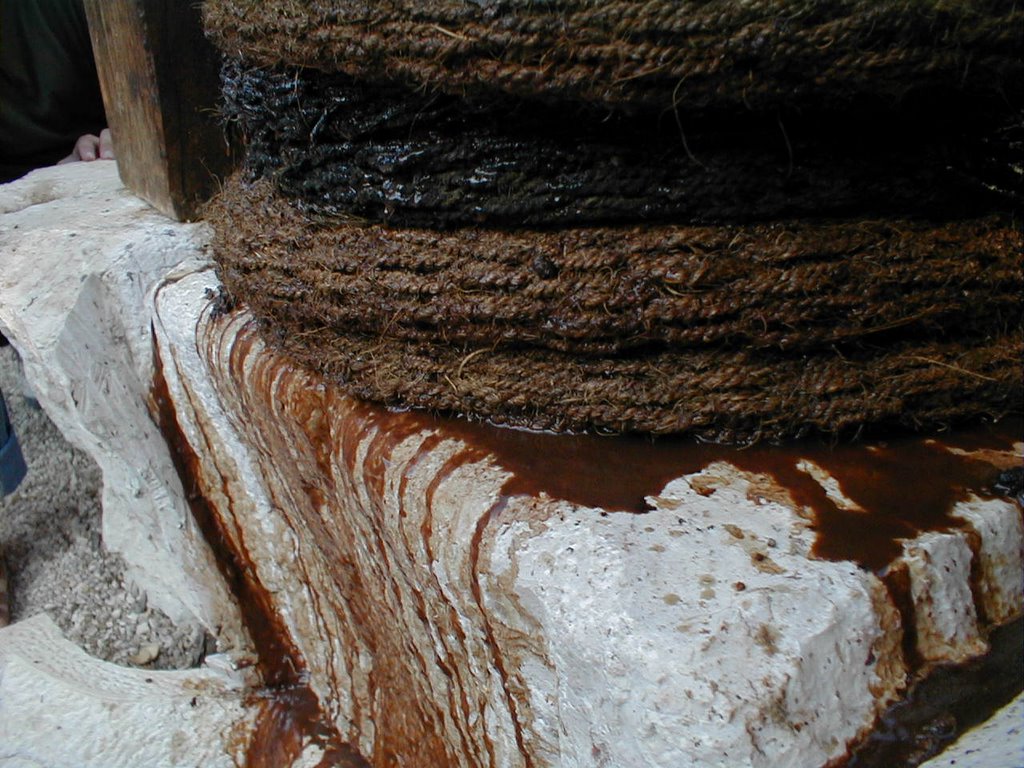
The very process by which olive oil was produced is also very significant and symbolic. To produce the oil, you had to first crush the olives with a huge stone wheel that turned the olives into a pulp like mush. Large woven bags were then filled with the pulp and placed under the gethsemane, or olive press. "The mash sacks were placed towards the front of the beam under a round pressing board. Large stones were used to weigh down the beam pressing upon the mash sacks." [1] Additional weight was added until the olive oil began to spill from the woven bag into the collecting bowls. Because of the crushed rinds of the olives, the oil was actually brownish red in color, giving it the appearance of blood. [2]

Note how the olive oil is reddish-brown in color (from Satterfield)
The symbolism of olive oil and the suffering that Christ endured in this garden of the press is laden with significance. Christ in the Gospel of John states that He is the Light of the world (see John 8:12). It is through His precious blood that our way has been illuminated. Christ is the ointment that will not only heal our souls, but give a sweet fragrance to the bitter difficulties we face in life. It is through His precious blood that our wounds are healed. Christ also stated that He was the bread of life, a critical ingredient of ancient bread being olive oil. It is through His precious blood that we can have the bread of life, and live forever (see John 6:51). Even the very name Christ in Greek and Messiah in Hebrew mean anointed. [3] Thus, Jesus was the anointed one in every aspect, the great King of kings, the High Priest, the holy Prophet.

Christ alone paid the price for sin. He had the weight of the world press down upon Him, crushing Him until He bled from every pore. How grateful I am that on this night the Christ would be willing to bear the burden of my sins, that I might be healed.

In 2007 I had the chance to sit in the Garden of Gethsemane in Jerusalem. As I sat there in the Church of All Nations (the Catholic Church located in the garden), I felt a great pain for the suffering that Christ suffered on my behalf. I sat there completely alone in the church and thought of when He was completely alone in the garden. I sat there in dark (the chapel is intentionally dark to represent night) as I thought of how the Messiah knelt in darkness, pleading on my behalf to the Father. As He bore my burden, blood came from every pore. As these thoughts filled my mind, I was then filled with the most joyous happiness I have perhaps ever felt. I did not feel guilt for His pain, I felt peace. I did not feel anxiety for the suffering I caused Him, I felt forgiveness. I did not feel sadness for causing such anguish, I felt pure love.

I love my Savior, and will be eternally grateful for that which He did for me, in a garden called Gethsemane. In a garden that by its very name symbolizes the freedom, life, and light that has been brought into my life through His precious blood.

[1] Gethsemane, by Bruce Satterfield of BYU-Idaho
[2] For pictures showing entire process of making olive oil see Gethsemane, by Bruce Satterfield
[3] See Mashiach (Hebrew) and Christos (Greek) in Strong's Concordance

July 2, 2013

Perfection and Grace


Excerpt from a talk I gave in church last week:

What does it mean to be perfect?

The scriptures teach us that “Noah was a just man and perfect” (Gen. 6:9). Abraham was commanded by the Lord to “walk before me, and be thou perfect” (Gen. 17:1). Job also “was perfect and upright” (Job 1:1). The Savior himself taught us to “be ye therefore perfect, even as your Father which is in heaven is perfect” (Matt. 5:48).

So the question is what is perfection? If Noah, Abraham, Job, and others were able to obtain perfection, and if the Savior himself has commanded us to be perfect, than how do we accomplish this? Can we really be perfect in this life?

The question must be asked then, what does it mean to be perfect? The word ‘perfect’ in Greek means to be ‘complete’ or ‘whole.’ Thus the connotation of being perfect, meaning sinless, is actually a more modern interpretation of the word perfect. When the scriptures speak of perfection, as in the case of Job and Abraham being perfect, it does not mean being without sin. If this was the case, none of us would be able to be perfect. Let me be clear, there was only One sinless being, thus if perfection is being sinless, than we will never be perfect.

What then does it mean to be perfect, if being perfect does not mean sinless? Can we really be "perfect, even as [our] Father which is in heaven is perfect." Can we actually become like the Father and the Savior? I think we all have struggled with this question, I in particular.

President Ezra Taft Benson said that “we must be careful, as we seek to become more and more godlike, that we do not become discouraged and lose hope. Becoming Christlike is a lifetime pursuit and very often involves growth and change that is slow, almost imperceptible. The scriptures record remarkable accounts of men whose lives changed dramatically, in an instant, as it were: Alma the Younger, Paul on the road to Damascus, Enos praying far into the night, King Lamoni. Such astonishing examples of the power to change even those steeped in sin give confidence that the Atonement can reach even those deepest in despair.

“But we must be cautious as we discuss these remarkable examples. Though they are real and powerful, they are the exception more than the rule. For every Paul, for every Enos, and for every King Lamoni, there are hundreds and thousands of people who find the process of repentance much more subtle, much more imperceptible. Day by day they move closer to the Lord, little realizing they are building a godlike life. They live quiet lives of goodness, service, and commitment. They are like the Lamanites, who the Lord said ‘were baptized with fire and with the Holy Ghost, and they knew it not.’ (3 Ne. 9:20; italics added.)” (“A Mighty Change of Heart,” Ensign, Oct. 1989)

What is grace?

To understand perfection, it is helpful first to understand what the Lord means when He says that we should be perfect. It is also helpful to know how perfection will be determined at the judgment. Let me explain perfection by first explaining grace.


I remember as a teenager being taught that grace was similar to as if you fell into a pit, and the only way to get out is if you can build yourself a ladder. You find pieces of wood on the floor of the pit, and you begin to build. However, you do not have enough sticks to build the ladder all the way up the side of the pit. This (as explained by my teacher) is where grace comes in. Our works, they said, represent the portion of the ladder we make, and the remaining distance to get out of the pit represents the grace of Christ. In other words, Christ makes up the difference so that we can make it out of the pit.

Christ does not make up the difference! He is the difference! He is the reason we can get out of the pit. We do not create the ladder, He built the ladder, and we climb out. Christ is the difference!

Two scriptures to back this up. When speaking of Jacob, Lehi said “Wherefore, I know that thou art redeemed,” now note why Lehi says that Jacob is redeemed “because of the righteousness” of who? “because of thy Redeemer” (2 Nephi 2:3).

And in another scripture in the Doctrine and Covenants the Savior says “Listen to him who is the advocate with the Father, who is pleading your cause before him—saying: Father, behold the sufferings and death of him who did no sin, in whom thou wast well pleased; behold the blood of thy Son which was shed, the blood of him whom thou gavest that thyself might be glorified; wherefore, Father, spare these my brethren that believe on my name, that they may come unto me and have everlasting life.” (D&C 45:3-5)

Notice that nowhere in this verse does the Savior actually point to our works of righteousness. When judgment comes it is the Savior who is on trial, and because He lived a sinless life, He then can turn to the Father and ask for us to be saved through Him. In essence He says “judge them the way you would judge me, and because I was sinless, judge them to be sinless.”

So then, what is perfection? Again, it is not that we are sinless. It is that Christ is sinless, and we are not judged because of our merits, but because of His merits.

Why do we need grace?

Image our life is like a college degree. We are told that we are to be perfect (or receive a 4.0). We do everything we can our first semester to be ‘perfect’ but we get one B+. The question is can we ever now get a 4.0? What if we work really hard and get 4.0s the rest of our college years? We never really will be able to accomplish a 4.0. We may get close, but we never will be able to get that perfect 4.0.

Only the Savior has received a 4.0. Only He has lived a life which would merit any reward. We do not deserve the blessings we receive. Only the Savior deserves salvation and exaltation.

Bruce R. McConkie said “Now let us suppose a modern case. Suppose we have the scriptures, the gospel, the priesthood, the Church, the ordinances, the organization, even the keys of the kingdom—everything that now is, down to the last jot and tittle—and yet there is no atonement of Christ. What then? Can we be saved? Will all our good works save us? Will we be rewarded for all our righteousness?

“Most assuredly we will not. We are not saved by works alone, no matter how good; we are saved because God sent his Son to shed his blood in Gethsemane and on Calvary that all through him might ransomed be. We are saved by the blood of Christ (Acts 20:28; 1 Cor. 6:20).

“To paraphrase Abinadi: ‘Salvation doth not come by the Church alone; and were it not for the atonement, given by the grace of God as a free gift, all men must unavoidably perish, and this notwithstanding the Church and all that appertains to it’” (Doctrines of the Restoration: Sermons and Writings of Bruce R. McConkie, ed. Mark L. McConkie [1989], 76).

How do works fit in?

So how do works come in? Why are works important? Can't we just be saved by the grace of Christ?

Paul taught “For by grace are ye saved through faith; and that not of yourselves: it is the gift of God: not of works, lest any man should boast. For we are his workmanship, created in Christ Jesus unto good works, which God hath before ordained that we should walk in them.” (Ephesians 2:8-10)

So in other words Paul is teaching that it is through grace that we are saved, not through works. But we also have Nephi who taught “For we labor diligently to write, to persuade our children, and also our brethren, to believe in Christ, and to be reconciled to God; for we know that it is by grace that we are saved, after all we can do.” (2 Nephi 25:23)

So how do grace and works relate? The way I like to explain it is that grace is what saves us; Paul is correct when he says that it is by grace that we are saved. Our works, however, give us access to His grace. It would be similar to saying that the Lord has built a mansion for us, a beautiful home like no other and we are allowed to live in it. The catch is that Christ does not have the key to the mansion, we do. For us to be able to enjoy the blessings of this beautiful mansion, we must insert the key and open the door and go into the home. But it is His home, He was the one who built it, He spent the money. He hired the architect, the builders, the craftsmen, etc. It is nothing that we did, but if we don’t actually turn that key to open that door, we cannot go inside. Our works are the key to enjoying the grace of Christ.

The reason I share this about the significance of grace is because I feel that we often focus on works (after all that is what we must do, that is our part), and we forget about who really saves us. It is the Savior who saves us in the end. Our works, such as having faith, repenting, baptism, serving others, paying tithing, going to church, etc. only give us access to His grace. In the end, it is by “grace that we are saved.”

Inside the Church of All Nations in the Garden of Gethsemane
I want to close with my testimony. In 2007 I had the blessing to live in Jerusalem for two months. While there, I often visited the Garden of Gethsemane. In the garden there is a beautiful Catholic church called the church of all nations, which was designed specifically to be dark inside to imitate that dark night 2000 years ago. I had the chance to sit in the church on one occasion, and no one was in the church. I remember sitting there in that room and the thought came to me of all the sins that I had committed and all the things that I had done which made the Savior suffer at this very location, and then all of a sudden the pain was gone. Instead, my pain was replaced by joy and happiness. As I sat there, I could not help but feel a deep sense of gratitude and love for my Savior. It is something I will never forget.

I don’t deserve the blessings that He is willing and able to give. The blessings that He will give, we do not deserve. That is perhaps the greatest sign of God's love. He is blessing us with something that we do not deserve.

I testify that the Savior did die on the cross and that through Him and through his atonement we can be saved. I testify that because of His grace we can be perfect, because He is perfect. Of this I testify in his sacred name, even Jesus Christ, amen.

March 24, 2013

Had I Been There


The script I wrote for our Church Easter Program last year.

Today, with millions of Christians around the world, we commemorate the most significant single day in the history of the universe. As we read from the four Gospels, and from the words of modern-day apostles and prophets, let us ponder the valuable and penetrating question of how we would have responded had we been there in Jerusalem during the Last, Holy Week of the Savior’s mortal life.

As Raymond Brown, a renowned Catholic scholar wrote: “[Would I have welcomed Jesus with palm branches, and shouts of acclimation?] Is it not more likely that I might have been among the disciples who fled from danger, abandoning him? Or at moments in my life have I not played the role of Peter, denying Jesus, or even of Judas, betraying him? Have I not found myself like ... Pilate, trying to avoid a decision between good and evil, [or washing] my hands so that the record could show that I was blameless? Or, most of all, might I not have stood among the religious leaders who condemned Jesus?” (A Crucified Christ, by Raymond Brown, pg. 11-12)

At this time, let us also ponder the perfect and selfless example of the Savior. During His most agonizing, and trying trials, He turned towards others and served them. When He needed comfort, He comforted others. When He needed strength, He bore our burdens to strengthen us. May we ever more, allow the Savior into our lives by becoming more faithful disciples of the Lord, and by following His perfect example.
____

On the Thursday of that Holy Week, the Savior held a special Last Supper with His apostles. During this meal He instituted the holy sacrament, washed the dusty feet of His disciples, and taught them and comforted them. Some of the greatest teachings of all scripture are contained in this evening discourse that Jesus gave; a discourse that was meant to comfort and encourage His apostles on this night when all would seem lost.

“Peace I leave with you, my peace I give unto you: not as the world giveth, give I unto you. Let not your heart be troubled, neither let it be afraid.” (John 14:27) “I am the way, the truth, and the life: no man cometh unto the Father, but by me.” (John 14:6) “In the world you shall have tribulation, but be of good cheer, I have overcome the world.” (John 16:33) “Greater love hath no man than this, that a man lay down his life for his friends.” (John 15:13) “This is my commandment, That ye love one another, as I have loved you.” (John 15:12)
____

After the Last Supper, Jesus took his disciples to the Mount of Olives. “And they came to a place which was named Gethsemane: and he saith to his disciples, Sit ye here, while I shall pray. And he taketh with him Peter and James and John, and began to be sore amazed, and to be very heavy; And saith unto them, My soul is exceeding sorrowful unto death: tarry ye here, and watch. And he went forward a little, and fell on the ground, and prayed that, if it were possible, the hour might pass from him. And he said, Abba, Father, all things are possible unto thee; take away this cup from me: nevertheless not what I will, but what thou wilt. And he cometh, and findeth them sleeping, and saith unto Peter, Simon, sleepest thou? couldest not thou watch one hour? Watch ye and pray, lest ye enter into temptation. The spirit truly is ready, but the flesh is weak. And again he went away, and prayed, and spake the same words. And when he returned, he found them asleep again, (for their eyes were heavy,) neither wist they what to answer him. And he cometh the third time, and saith unto them, Sleep on now, and take your rest: it is enough, the hour is come; behold, the Son of man is betrayed into the hands of sinners. Rise up, let us go; lo, he that betrayeth me is at hand.” (Mark 14:32-42)
____

After the excruciating suffering of Gethsemane, Jesus was arrested and taken before both the Jewish and Roman authorities to be judged. On that Friday morning the Creator of the universe, the Great High Priest, the King of kings and Lord of lords was condemned to death for being the very King He was. During these harrowing moments, no one stood with Him. All had fled. All had forsaken Him.

“Then the soldiers of the governor took Jesus into the common hall, and they stripped him, and put on him a scarlet robe. And when they had platted a crown of thorns, they put it upon his head, and a reed in his right hand: and they bowed the knee before him, and mocked him, saying, Hail, King of the Jews! And they spit upon him, and took the reed, and smote him on the head. And after that they had mocked him, they took the robe off from him, and put his own raiment on him, and led him away to crucify him. And when they were come unto a place called Golgotha, they crucified him. And they that passed by reviled him, saying, Thou that destroyest the temple, and buildest it in three days, save thyself. If thou be the Son of God, come down from the cross. Likewise also the chief priests mocking him, with the scribes and elders, [saying] He saved others; himself he cannot save. If he be the King of Israel, let him now come down from the cross, and we will believe him. He trusted in God; let him deliver him now, if he will have him: for he said, I am the Son of God.” (Matthew 27:27-43)

Elder Joseph B. Wirthlin said: “Each of us will have our own Fridays—those days when the universe itself seems shattered and the shards of our world lie littered about us in pieces. We all will experience those broken times when it seems we can never be put together again. We will all have our Fridays. But I testify to you in the name of the One who conquered death—Sunday will come. In the darkness of our sorrow, Sunday will come. No matter our desperation, no matter our grief, in this life or the next, Sunday will come.” (Sunday Will Come, October 2006).
____

“Now upon the first day of the week, very early in the morning, [the women] came unto the sepulchre, bringing the spices which they had prepared, and certain others with them. And they found the stone rolled away from the sepulchre. And they entered in, and found not the body of the Lord Jesus. And it came to pass, as they were much perplexed thereabout, behold, two men stood by them in shining garments: And they said unto them, Why seek ye the living among the dead? He is not here, but is risen: remember how he spake [unto you] saying, The Son of man must be delivered into the hands of sinful men, and be crucified, and the third day rise again. And they remembered his words, And returned from the sepulchre, and told all these things unto the eleven, and to all the rest.” (Luke 24:1-9)
____

The scriptures record of many others who were witnesses of the resurrected Lord: Mary Magdeline, Peter, the apostles, Paul, James, the Nephites and Lamanites of 3 Nephi, and hundreds of others. In our day, the risen Lord has appeared once again, visiting Joseph Smith the prophet, and countless others. Today each of the Apostles is a special witness of Christ’s divinity. Only two weeks before his death, Elder Bruce R. McConkie testified, “I am one of his witnesses, and in a coming day I shall feel the nail marks in his hands and in his feet and shall wet his feet with my tears. But I shall not know any better then than I know now that he is God’s Almighty Son, that he is our Savior and Redeemer, and that salvation comes in and through his atoning blood and in no other way. God grant that all of us may walk in the light as God our Father is in the light so that, according to the promises, the blood of Jesus Christ his Son will cleanse us from all sin.” (The Purifying Power of Gethsemane, April 1985)
____

As we contemplate the singular events of the death and resurrection of the Lord and Savior, let us remember the words of Elder Jeffrey R. Holland when he said, “My ... plea at Easter time is that these scenes of Christ’s lonely sacrifice, laced with moments of denial and abandonment and, at least once, outright betrayal, must never be reenacted by us. He has walked alone once. Now, may I ask that never again will He have to confront sin without our aid and assistance, that never again will He find only unresponsive onlookers when He sees you and me along His Via Dolorosa in our present day. As we approach this holy week—Passover Thursday with its Paschal Lamb, atoning Friday with its cross, Resurrection Sunday with its empty tomb—may we declare ourselves to be more fully disciples of the Lord Jesus Christ, not in word only and not only in the flush of comfortable times but in deed and in courage and in faith, including when the path is lonely and when our cross is difficult to bear. This Easter week and always, may we stand by Jesus Christ “at all times and in all things, and in all places that [we] may be in, even until death,” for surely that is how He stood by us when it was unto death and when He had to stand entirely and utterly alone.” (None Were with Him, April 2009)

Let us this Easter season, renew our efforts to feed the hungry, to lift up the hands of those that hang down, to strengthen the feeble knees, and to comfort those who stand in need of comfort. In short, let us follow the example of the Savior, who when all was dark, brought light to those around him by serving, lifting, and comforting. Let us also, with those of old, be witnesses of Christ in all things. Truly we have reason to rejoice, for Christ the Lord is Risen today!

January 23, 2013

The Law of Sacrifice and the Messiah


This is a video I put together from a slide show produced about the Law of Moses by the Church Education System (CES). It is one of the best discussions I have ever seen on the topic of the Law of Sacrifice and the mission of the Savior. It goes into great detail describing the various ordinances of the Law of Moses and how they represented the future sacrifice of the Messiah. It is about 25 minutes in length and is not the most exciting video, but very informative and I think very well worth the time. Because it is so difficult to get a copy of the slides (it was produced in 1980, and no longer used), I decided to publish it on YouTube with the hopes that more people may use it and learn of this difficult yet important part of the Old Testament.

January 16, 2010

Our Own Lost 116 Pages

Joseph Smith translating the plates by Robert T. Barrett
In the book of Doctrine of Covenants we learn of a story in which the Prophet Joseph Smith was commanded to translate the ancient record of the ancient inhabitants of America. These people knew of Christ and recorded their testimonies about him in what we know of today as the Book of Mormon. As Joseph began to translate this record he was asked by his scribe Martin Harris to allow him to show the completed manuscript to his wife. Joseph was very reluctant to allow Martin to do this, but prayed to the Lord because of Martin’s insistencies. First the Lord told Joseph that he was not allowed to give the transcript to Martin. However, after asking two more times the Lord granted Martin Harris the chance to show the documents to his wife and a few other specific people.

A few weeks later Martin returned to the home of Joseph without the manuscript. He had lost the 116 page manuscript and had no idea where it was. All the work they had done was lost. For a time the spirit withdrew from Joseph and he was left to sorrow after the loss, not knowing what would come in the future. However, the Lord had planned for this mistake, centuries before when He commanded the ancient prophet Nephi to make two accounts of his record; one that was more historical, the second more spiritual in nature. When Joseph was again allowed to translate the ancient record, he was told to translate the second account. This was to ensure that those who had stolen the original manuscript would not be able to use it to damage the Church of God by changing it or adding to it for their own benefit. Thus, we learn that the Lord in His wisdom had planned for this error on the part of Joseph thousands of years before. He knew exactly how things would unroll and had made compensation for those events that would happen in the future.

Each of us has our own lost 116 pages in essence. Each of us has made severe mistakes that will not only thwart the work of God, but will prevent us from blessing the lives of others to the full extent that we could otherwise. Often these are direct sins that we have committed, while other times they are careless mistakes we have made, or circumstances that we could not prevent. On our own, these events would make eternal progression impossible. Yet, as shown by this story of Joseph and the lost 116 pages, the Lord knows all things. He has provided for a way for us to overcome all things. Even our very sins have been not only forgiven but the wrongs we have committed will be made right. This means that when we sin or make a mistake we can know that we can be not only forgiven but that those who we have offended or hurt will likewise be blessed to have all things resorted unto them as if we had never sinned against them.

In short, compensation has been made for not only our personal actions, but the consequences of our actions. Because of this we can put our faith in the Lord that He can and will make all things whole. When we make a mistake, we must move forward and allow the power of the atonement to work in us and in those around us. As we learn of this power, we will have an increased faith in the Savior. We will know that we can do all things, and that no matter how many times we make a mistake, the Lord has provided a way for us to overcome it. Because He knows all things, we will never surprise Him with a new problem or a new challenge that He is not quite sure how to overcome. In fact, He has already proved a means to overcome all things centuries before we came to this earth by allowing the His Son to suffer in a garden called Gethsemane. Because the Savior knew all things that would happen, He paid the price for ALL sins and made ALL things right.

I invite you to look in the scriptures for moments like that of the lost 116 pages where the Lord made compensation for that which would take place in the future. As we learn of these stories we will increase in faith and hope that the Lord will do the same for us. This is my testimony, that the Lord has made all things right, not just after we have made a mistake, but centuries before hand, showing His power and eternal love for us. I have seen His power in my own life and have seen time and time again when He has made full compensation for those mistakes and sins that I have committed. Let us go forward in faith and not look back on the past, let us put our faith in the Lord who WILL make ALL things right!